
Reviewed · WALKING TOURS
Birmingham Walking Tour: Canals, Victorians & Today (1:30pm)
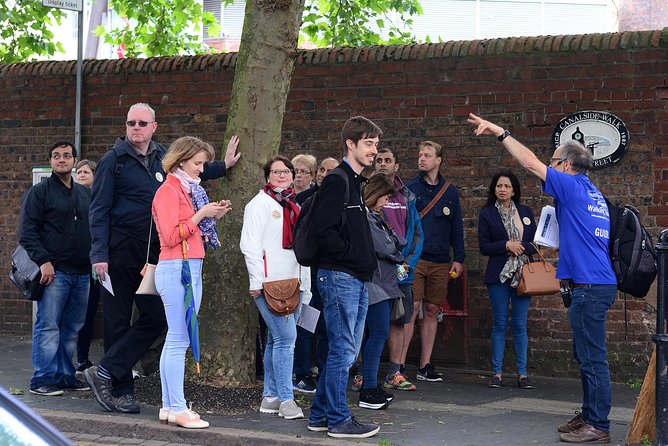
Canals and Victorian Birmingham in one walk. What makes this outing so useful is how it stitches together the city center, from civic landmarks to canal atmosphere, into one logical stroll. I love the live audio setup, which keeps your listening clear without shoulder-to-shoulder crowding. I also like that the route hits both grand public buildings and the quieter canal moments, so you get a real feel for Birmingham, fast. One drawback to plan for: it is a short, stop-and-go format, so if you want long, slow canal time, you will feel a little rushed.
You start at the Library of Birmingham, a modern showpiece right in Centenary Square. From there, the guide links the past and the present as you move between event hubs, redeveloped waterfront areas, and Victorian-era civic spaces. The pacing is brisk but fair, and there is enough time at each stop to understand why it matters.
Because the tour is about 2 hours on city sidewalks, it works best if you have moderate fitness and comfortable walking shoes. The experience is designed for English speakers and capped at 35 people, so it stays manageable. And yes, the guide brings energy, often the quick humor and story style that makes the city feel less like a list and more like a place with a personality, whether the guide is Jonathan or Michael.
In This Review
- Key highlights worth your attention
- Kicking off at the Library of Birmingham and Centenary Square
- The ICC and Symphony Hall: where Birmingham hosts the world
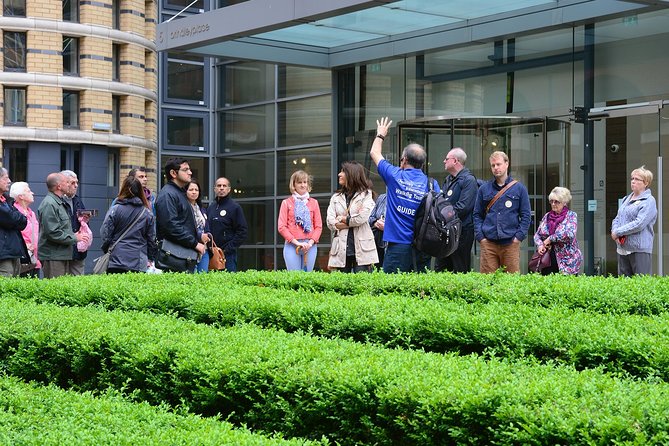
- Brindleyplace and the story of old waterfronts becoming destinations
- Gas Street Basin: where the canal network feels real
- Victoria Square and Chamberlain Square: public art and the Victorian to modern arc
- Birmingham Museum and Art Gallery: the 1880s double portico moment
- The Mailbox and The Cube: redevelopment, work life, and city views
- The Ikon Gallery and Hall of Memory: Martin and Chamberlain meet WWI to now
- ICC Mall and Birmingham Town Hall: the old civic spine
- Price, value, and who this walking tour suits best
- Should you book Birmingham Canals, Victorians and Today?
- FAQ
- Where does the tour start and end?
- What time does the walking tour begin?
- How long is the tour?
- How much does the tour cost?
- What language is the tour offered in?
- Is admission included for all stops?
- How does the audio work on this tour?
- Is the tour group size limited?
- Do I need a high fitness level to join?
- What happens if the weather is bad?
- Is there free cancellation?
Key highlights worth your attention
- Live audio you can actually hear, via a receiver and radio transmitter guide.
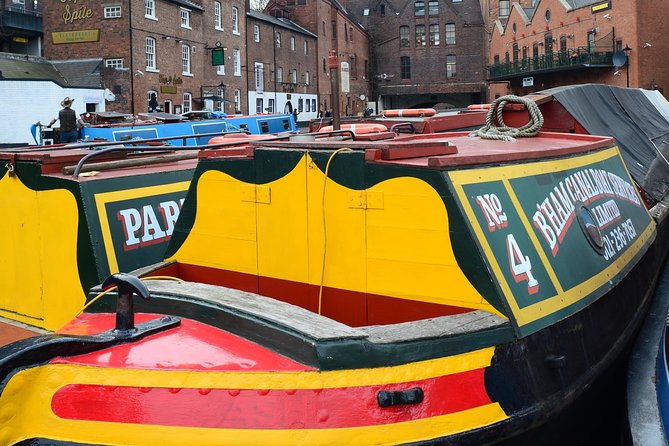
- Gas Street Basin in the canal story, with an atmospheric look at Birmingham’s waterway era.
- Victorian to today street sequence, moving through Victoria Square, Chamberlain Square, and beyond.
- Major redevelopment stops, including Brindleyplace, The Mailbox, and The Cube.
- Art deco and memorial design at Hall of Memory, including details tied to William Bloye.
- First-day orientation that saves time, especially if you only have a couple of hours.
Kicking off at the Library of Birmingham and Centenary Square
The tour starts and ends at the Library of Birmingham on Centenary Square, and that is a smart choice. The building is a major new attraction in the city, so it gives you a clean anchor point right where Birmingham expects tourists to gather. You will also get a good first lesson in how the city presents itself now, before the walk starts turning the pages back toward earlier eras.
You spend around 10 minutes here. That is not enough time for a deep museum-style visit, but it is perfect for setting context. The guide uses this first stop to frame what Birmingham does well: practical architecture, civic ambition, and a tendency to reinvent itself when industries and city needs change.
I like that you do not begin with a maze of smaller sights. You start with a single, unmistakable focal point. If you are arriving in town and want to get your bearings fast, this helps. And because you end back at the same spot, you can tack on a meal or a quick ride home without worrying where you will pop out.
If you are someone who enjoys modern architecture as much as historic buildings, this start fits your taste. If you are the type who wants only medieval charm, you might find yourself thinking, okay, where is the old stuff. The tour answers that quickly once you move into the civic squares and the Victorian-era pieces.
More Walking Tours in Birmingham
- Discovering Birmingham 2 hour Walking Tour to the Jewellery Quarter
★ 5.0 · 333 reviews - Birmingham Slogging Gangs Walking Tour with Edward Shelby
★ 4.5 · 306 reviews - Birmingham City Centre Daily Walking Tour (10:30am & 2pm)
★ 5.0 · 265 reviews
The ICC and Symphony Hall: where Birmingham hosts the world
Next up is the International Convention Centre Birmingham and Symphony Hall. This is a short stop, about 10 minutes, but it gives you something many city walks skip: the role of large venues in shaping a place.
The guide looks at the ICC and Symphony Hall and ties them to Birmingham’s wider identity, not just what is inside the buildings. Even if you do not attend a show or an event, you start to see the logic behind why the surrounding city spaces have the layout they do. Big event buildings pull in visitors, create circulation routes, and influence how the city grows around public life.
This part works especially well if you like understanding cities as systems. Birmingham is often described through industry, but it is also a modern service and events city. Seeing the ICC and Symphony Hall early makes that clear before the walk shifts to the canals and older civic squares.
A practical note: because this is a stop focused on overview rather than entry, you will not feel like you missed out on paying museum time. You are paying for narrative and orientation. The receiver and audio setup also help here, since you can keep walking while still hearing the guide’s comments.
Brindleyplace and the story of old waterfronts becoming destinations
Brindleyplace is another 10-minute chapter, and it is all about transformation. The guide looks at the history of Brindleyplace and what it is today. The value here is in the contrast.
You get to connect what a waterfront area used to be for with what it became when the city shifted away from heavy industrial dominance and toward a mix of leisure, offices, and public spaces. You are not looking at one single monument. You are reading an area the way locals do, as a sequence of changes.
What I like is that this stop does not ask you to memorize facts. It asks you to notice patterns. When you see how the canal and river-adjacent areas were repurposed, the rest of the walk makes more sense. Gas Street Basin will feel like more than a pretty scene. Victoria Square will feel like more than a place to take photos.
Possible drawback: if you were hoping for a super detailed architectural walking tour with slow pauses for close-up details, you might want more time here. The tour keeps stops tight, and you move on while the impressions are still fresh.
Gas Street Basin: where the canal network feels real
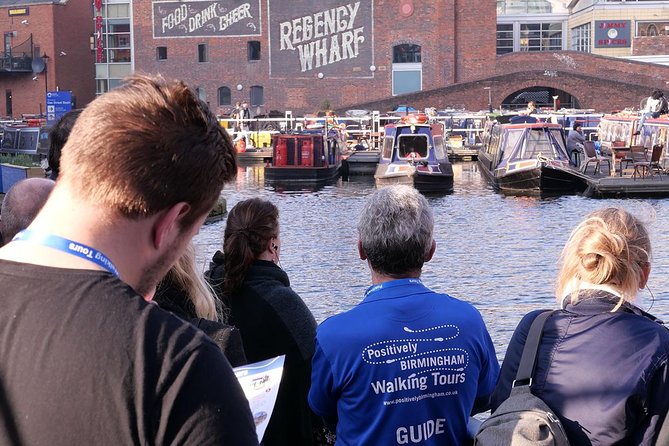
Then comes Gas Street Basin, about 15 minutes, and this is one of the route’s emotional anchors. The guide connects the coming of the canals to the atmosphere of this canal center and the wider canal network across the country. In practical terms, you are learning how Birmingham became a water-transport hub, and why those water corridors still shape the city’s layout.
This stop stands out because it is not only about history. It is also about vibe. You get a sense of why people still come to canal basins for walks, photos, and an easy break from traffic noise. The tour gives you the background so you are not just looking at water and bridges.
If your favorite parts of Britain are the bits that feel workaday but beautiful, you will appreciate how the guide frames it. It is the difference between seeing a canal as scenery and seeing it as infrastructure that changed trade, industry, and daily life.
One consideration: the tour’s structure means you get time to look around, but not long enough to do a full canal walk out and back. If you want extended time on the water, plan to keep going after the tour ends back at Centenary Square, or plan another canal-focused outing on a different day.
Same part of England, a different sort of day out:
- Shrewsbury Prison Guided Tour
★ 5.0 · 2,628 reviews - Entry ticket to Hoo Zoo and Dinosaur World in Telford
★ 5.0 · 591 reviews - Cadbury World Entry Ticket
★ 3.0 · 524 reviews - Shrewsbury Prison Entry Ticket
★ 4.5 · 426 reviews
Victoria Square and Chamberlain Square: public art and the Victorian to modern arc
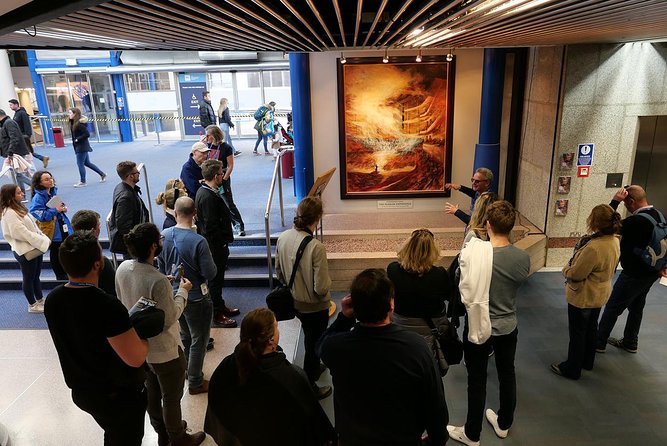
Victoria Square is a key 10-minute stop. You will consider public art here and how Birmingham developed during the Victorian period, then what the city looks like now. That is a lot to fit into one quick block, but it is the right approach for a first pass. The guide helps you spot what changed and why.
After that, you move to Chamberlain Square for about 10 minutes, focused on the way Birmingham is moving into the future. Put together, these two stops give you a strong timeline in a small radius. Victorian confidence sits beside newer decisions about public space, civic identity, and what the city chooses to show off.
What I like is the balance. You are not only stuck in the past, staring at old stone. You also learn how the city is currently shaping its public face. And because Birmingham has a reputation for both industry muscle and redevelopment, these squares help you understand that mix.
Potential drawback: if you only care about one era, you might find yourself mentally splitting your attention. That said, the pace is short enough that it feels like a curated walk rather than a lecture.
Birmingham Museum and Art Gallery: the 1880s double portico moment
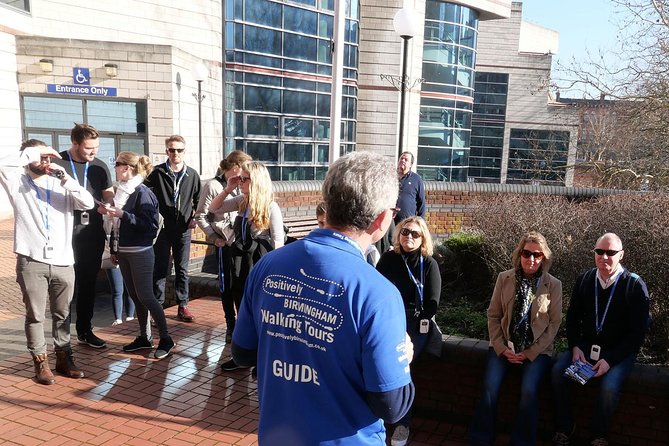
Now you get a more architectural stop at Birmingham Museum and Art Gallery. You pass the entrance and focus on the amazing 1880s design, specifically the double portico. Admission is included for this part, so you are not fighting extra ticket steps.
This is one of the points where the tour becomes more than a street-level story. You get to experience a designed façade that signals civic pride. Porticos are not just decorative. They tell you how a city wants to frame culture and learning.
Even if you do not go deep inside on this short visit, the exterior detail is enough to change your perception of Birmingham. It stops being only brick-and-buses. You see ambition and taste applied to public institutions.
If you are traveling with kids or someone who gets impatient with long stops, this works well. It is quick, visually strong, and the guide can explain the design in plain terms.
The Mailbox and The Cube: redevelopment, work life, and city views
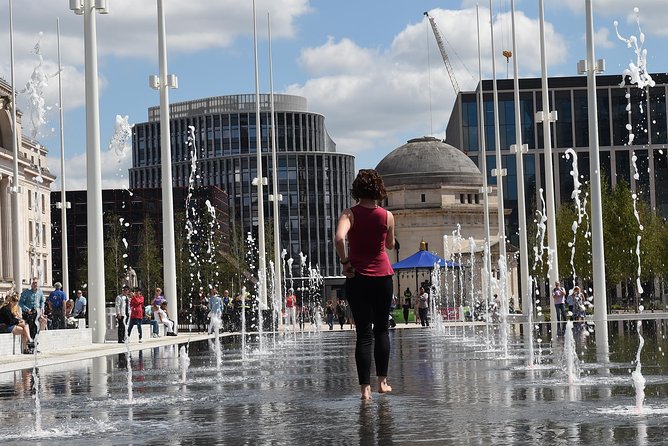
At The Mailbox, you look at the conversion of a former post office sorting office into a mixed-use development that includes the Birmingham headquarters of the BBC. That is a powerful detail, because it links national media history to local repurposing. The stop is about 5 minutes, and admission is included, but again, this is the quick-hit style.
What you learn is not only that buildings can change uses. You learn that Birmingham often keeps the shell and updates the function. That is a lesson that will help you appreciate the city as you walk through it later, even after the tour ends.
Right after that comes The Cube, a major development at the back part of the Mailbox area. Views from the upper floors are described as among the best in the city, and admission is included. This is where the tour gives you a payoff. You see Birmingham from above and connect the earlier ground-level stops to the bigger layout.
One possible drawback: you will want more time if you are the type who loves panoramic views. The included visit helps, but it is still a scheduled slot. Use the time to look around, identify key anchors, and mentally map the city.
The Ikon Gallery and Hall of Memory: Martin and Chamberlain meet WWI to now
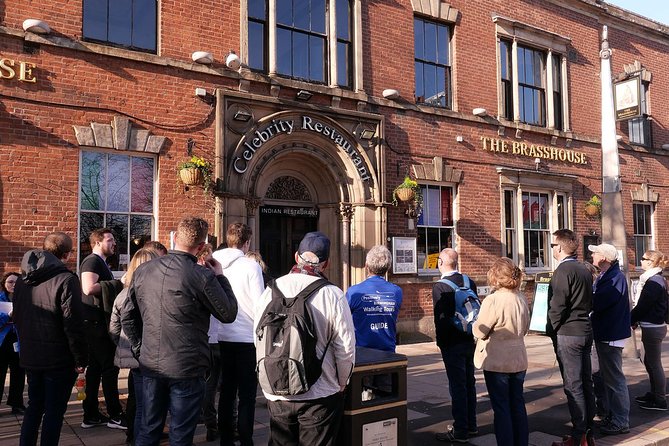
The next stop includes the Ikon Gallery, described as originally built as a school and one of over forty buildings created by the architects Martin and Chamberlain. Even without going deep into a museum visit, this tidbit matters. It explains why the building looks the way it does and how its purpose shifted over time.
This is a good reminder for you to keep your eyes open. Birmingham did not always have today’s roles for its buildings. Sometimes it borrowed space from education, industry, or civic use, and later reshaped it for art and public culture.
Then the tour heads to Hall of Memory for about 5 minutes, with admission free. This is an art deco memorial built originally in 1925 to remember those who fell in the First World War. The meaning has expanded over time, now including the Second World War and more recent conflicts.
Inside this short stop, the guide points out art deco features, including the William Bloye tablets. This part is worth paying attention to, even if you are not a memorial tour person. It gives the walk a human scale. Your understanding of Birmingham becomes less about architecture and more about what the city chose to remember.
If you have limited time in Birmingham, this is the moment that can stick with you longer than expected. It adds emotion to the city story without turning the walk into something heavy.
ICC Mall and Birmingham Town Hall: the old civic spine
The route continues through ICC Mall, described as the main route from Centenary Square to the canalside. This section is about 10 minutes, and it helps connect earlier landmarks into one clear walking spine. You start to see how Centenary Square functions like a hub, and how the canal direction shapes pedestrian movement.
After that comes Birmingham Town Hall, about 5 minutes. You get to see Birmingham Town Hall as the oldest building in Victoria Square, dating from 1834. That is a clean, date-based anchor, and it gives you a Victorian-era finish that feels earned after the modern stops.
This pair of stops is practical. You understand not only what to see, but how to move through the city afterward. When you know the main route from Centenary Square to the canalside, you can make your own plans with less guesswork.
And because you finish back where you started, the ending feels tidy rather than anticlimactic. You can turn this walk into a half-day plan by staying in the area for food or a final quick self-guided loop.
Price, value, and who this walking tour suits best
At $20.80 per person for about 2 hours, this is strong value for a city-center walking tour. Here is why: you are not paying for a long list of paid attractions. Many stops are free, and the ticketed elements are limited to specific entries like Birmingham Museum and Art Gallery, The Mailbox, and The Cube.
You also get the live audio system. In plain terms, that is what makes a group walk work well. You can follow the guide without needing to press close. You are loaned a receiver, and the guide uses a radio transmitter. You can bring your own earphones with a 3.5mm socket, or you can be provided a pair.
The pacing is another value factor. You see a lot of major landmarks without long queues or long transit between far-flung areas. With a maximum of 35 people, it stays organized. If your group is small, the experience can feel very personal, with plenty of room to ask questions.
Who should book?
- First-timers who want a smart orientation to Birmingham in a short window.
- People who like architecture and city planning, not just individual buildings.
- Travelers who enjoy canal stories but want historical context, not just a pretty walk.
- Anyone who would rather hear a guide explain how Birmingham connects its past to its present.
Who might pass?
- If you want slow museum time, you will need a separate plan for deeper indoor visits.
- If your main goal is only canals, you might want a longer canal-focused walk on a different day.
Should you book Birmingham Canals, Victorians and Today?
Yes, I would book it if you want a fast, well-structured Birmingham primer. This route gives you the backbone of the city center, with canals at Gas Street Basin, Victorian and civic storytelling through Victoria Square and Chamberlain Square, and a modern redevelopment sweep via Brindleyplace, The Mailbox, and The Cube.
It is also a smart buy for the audio system. If you hate craning your neck in a crowd, you will appreciate the receiver setup and the clear listening experience. And the guide energy matters here. The walk feels fun and lively, with names like Jonathan and Michael showing up as the kind of hosts who bring stories to life with humor and quick pacing.
If you have only one afternoon and you want to understand Birmingham beyond the surface, this one is an efficient pick.
FAQ
Where does the tour start and end?
It starts at the Library of Birmingham on Centenary Sq, Birmingham B1 2ND, UK, and it ends back at the same meeting point.
What time does the walking tour begin?
The start time is 1:30 pm.
How long is the tour?
The duration is approximately 2 hours.
How much does the tour cost?
The price is $20.80 per person.
What language is the tour offered in?
The tour is offered in English.
Is admission included for all stops?
Not all stops require admission. Several stops are listed as free, while Birmingham Museum and Art Gallery, The Mailbox, and The Cube include admission.
How does the audio work on this tour?
The tour uses a live audio system when available. Each guest is loaned a receiver to hear the guide who wears a radio transmitter. You can bring earphones with a 3.5mm socket or you may be provided with a new pair.
Is the tour group size limited?
Yes. The maximum group size is 35 travelers.
Do I need a high fitness level to join?
The tour is described as suitable for travelers with a moderate physical fitness level.
What happens if the weather is bad?
The experience requires good weather. If it is canceled due to poor weather, you will be offered a different date or a full refund.
Is there free cancellation?
Yes. You can cancel up to 24 hours in advance for a full refund.
Recently added around Birmingham
- Fun, Flexible Treasure Hunt Around Birmingham with Cryptic Clues & Hidden Gems★ 5.0 · 167 reviews
- Birmingham Gangs Nighttime Historical Walking Tour with Pub Stops★ 5.0 · 53 reviews
- Taste of Shrewsbury Food and Drink Tour with Guide★ 5.0 · 22 reviews
- Shrewsbury Prison Escape Room – The Hole★ 4.0 · 44 reviews
- Private Birmingham City Walking Tour★ 5.0 · 4 reviews
- Pride History of Birmingham Tour★ 5.0 · 3 reviews
- Private Birmingham Ghosts and Gallows Walking Tour★ 5.0 · 5 reviews
- Photography Walking Tour in Birmingham★ 5.0 · 42 reviews
Walking Tours, compared.
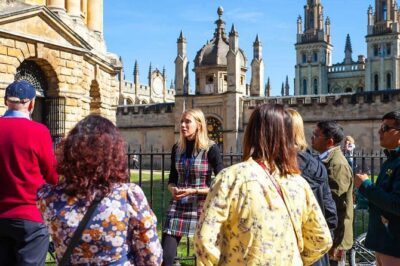
Oxford University Walking Tour With University Alumni Guide
Read our review →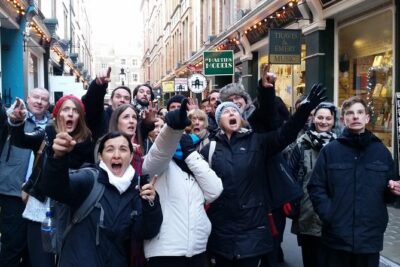
Tour for Muggles The Ultimate Harry Potter Walking Tour in London
Read our review →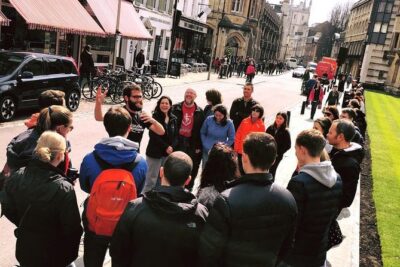
Cambridge University Walking Tour by Alumni™ Kings College Option
Read our review →
Blackbeard to Banksy – The Ultimate Walking Tour of Bristol
Read our review →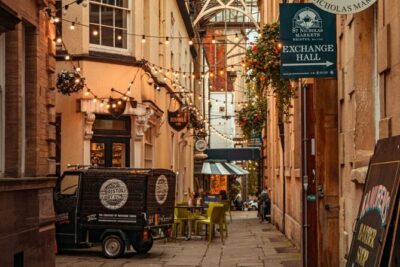
Air Raid Shelter + St. Nicholas Market Walking Tour
Read our review →
Walking Tour of Bath with Blue Badge Tourist Guide
Read our review →
Changing of the Guard Guided Walking Tour in London
Read our review →
Shadows of York: Ghost Walk and Horrible History.
Read our review →Browse the lists this tour appears in