
Reviewed · WALKING TOURS
Bristol Harbourside Self-Guided Walking Tour
Bristol’s harbourside stories are easier than you think. This self-guided walk strings together the city’s river, bridges, churches, and dock history into one smooth, audio-led circuit. I like that you can do it on your own pace, with a clear GPS route and Helen’s voice guiding you through the places you can actually see.
What I especially like is the human audio approach, with Helen guiding you and no computer-generated narration. I also like that the tour stays outdoors and at mostly free viewing spots, so you are not stuck paying entry fees just to enjoy the skyline, waterfront angles, and old stone-and-steel details. With a typical 2 to 3 hours on foot, it fits nicely into a day when you still want time for cafés and wandering.
One possible drawback: self-guided means you rely on the route directions, and in a few cases the navigation can feel less than perfect if streets are hard to read or if access is blocked. I suggest building in a little extra time and keeping a charged phone, just in case the walk stretches beyond the advertised pace.
In This Review
- Key highlights before you set off
- Value and what you get for $12.33 in Bristol
- Navigation tips so the harbourside loop stays fun
- Where the walk begins: Millennium Square at Canon’s Marsh
- From the waterfront amphitheatre to Pero’s Bridge
- College Green, King Street, and the squares where the city gathers
- Welsh Back and Castle Park, old harbor roots under everyday life
- Bridge Quay views and the Redcliffe church rebuild
- Redcliffe Caves and the dockside homes above them
- Dock basins and working harbor logic: Bathurst Basin to Princes Wharf
- The Matthew of Bristol and finishing with Brunel
- Who this self-guided harbourside walk is for
- Should you book this Bristol Harbourside self-guided tour?
- FAQ
- How long is the Bristol Harbourside self-guided walking tour?
- What is the price per person?
- Is the tour available in English?
- Do I get an audio guide?
- Is there an in-person guide with the tour?
- Are there admission tickets or entry fees for the stops?
- Where does the tour start and end?
- Is it easy to reach by public transportation?
- What if I need to cancel?
Key highlights before you set off
- Helen’s audio keeps the walk personal, with stories tied to what you’re seeing.
- GPS route and stop-by-stop map help you stay oriented without a live guide.
- Free-to-look-around stops mean you can focus on sights, not ticket lines.
- River-to-docks sequence connects Millennium Square, Redcliffe, and the working harbor feel.
- Brunel finish at the SS Great Britain area is a memorable way to end a loop.
Value and what you get for $12.33 in Bristol
For $12.33, what you are buying is time and structure. You get a self-guided app tour with map, directions, GPS route, and stop-by-stop content, plus unlimited access for 3 weeks after you start. That makes it easier to retry if you want the same walk at a different pace, or if one day you just do not feel like rushing.
You also get a proper audio guide. Helen guides you, and the narration is not computer-generated, which matters because you will spend a lot of minutes walking and listening. The app also includes videos, pictures, and recommendations, so you are not just hearing facts, you are getting ideas for what to do when you finish the route.
Another value point: many stops are marked as free to enter or view. That means your money goes mostly to the storytelling and navigation, not to stacking admission costs on top. The one place you may want to extend your time is M Shed, which is free to enter.
More Walking Tours in Bristol
- Blackbeard to Banksy – The Ultimate Walking Tour of Bristol
★ 5.0 · 1,961 reviews - Air Raid Shelter + St. Nicholas Market Walking Tour
★ 5.0 · 1,950 reviews - Ghosts, Ghouls & Gallows :The Original Bristol Ghost Walk
★ 5.0 · 262 reviews
Navigation tips so the harbourside loop stays fun
Because this is self-guided, your biggest enemy is confusion, not lack of things to see. The tour is designed around GPS directions, but Bristol streets near the harbourside can be a maze, and some segments can be inconvenient.
Here is how to make it smoother:
- Give yourself a buffer. Even if the walk is listed as about 2 to 3 hours, plan for a little extra if you pause for photos or if a detour happens.
- Watch for street-level signage. If the route asks you to turn where you can miss a name, take a second to confirm you’re on the right street before moving on.
- Keep the phone screen bright enough to read. You do not need to stare constantly, but you should be able to confirm the next stop without squinting.
- If a path looks blocked, follow the app’s reroute rather than forcing it. The harbourside changes with construction, foot traffic, and access rules.
Also, the tour runs daily with broad availability, so you can pick a time that matches your energy level. Since you are outdoors for much of it, daylight helps.
Where the walk begins: Millennium Square at Canon’s Marsh
Your first stop is Millennium Square, on the site of Canon’s Marsh. This is one of those Bristol locations where the ground looks calm now, but the story starts with water and changing land. The area was originally marshy land where the River Frome met the River Avon. Over time, the land was drained and built up, starting in the early 18th century.
This is a great opening because it gives you a mental map of Bristol: rivers first, then industry, then neighborhoods. As you start walking, that context helps you connect later stops like bridges, quays, and dock basins to what used to be natural waterways.
The stop is short, around 10 minutes, so treat it like orientation. Once you understand what used to happen here, the rest of the harbor walk makes more sense.
From the waterfront amphitheatre to Pero’s Bridge
Next you head toward Bristol Amphitheatre & Waterfront Square. It is known as a place where skateboarders ride, so you may spot them while you are there. If you like city texture, this is a good moment to notice how people use the space today, not just how it functioned in the past.
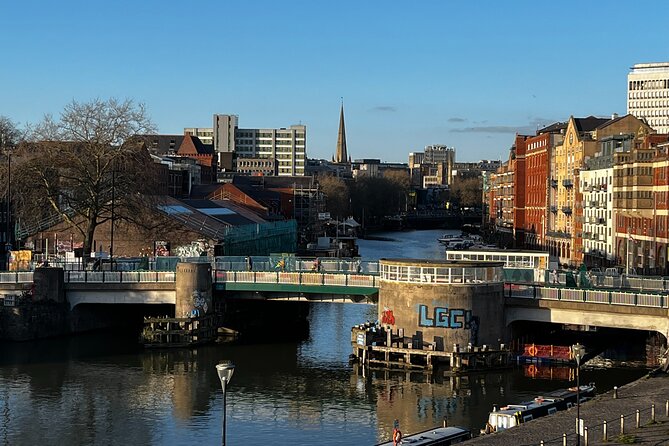
A few minutes later, you reach Pero’s Bridge. The bridge opened in 1999 and is named in honor of an important local figure. The bridge also has a pair of horn-shaped sculptures, and Helen explains the full story behind both the naming and the sculptures.
This stop is only about 5 minutes, but it is worth it. Modern Bristol details like this help you feel the timeline. You are not walking through a museum, you are moving through a living city that keeps building new landmarks.
Same part of England, a different sort of day out:
- West Country Games – the most popular group activity in the South West!
★ 5.0 · 315 reviews - The House Magicians Comedy Magic Shows
★ 5.0 · 263 reviews - Only Fools and Horses Tour of Bristol
★ 5.0 · 253 reviews - Guided Walking Tour of Bristol Old City and Harbour
★ 5.0 · 166 reviews
College Green, King Street, and the squares where the city gathers
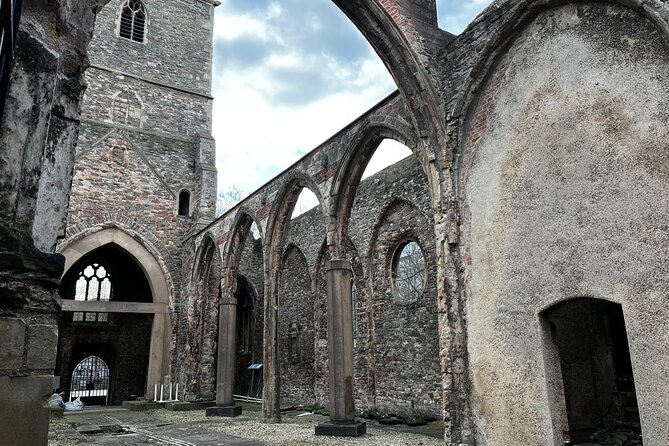
Then comes the “city-center heartbeat” stretch.
College Green is a popular gathering area, and the audio here points out an important church (Abbey), works of art by an extremely famous artist, another chapel, and a museum. This stop is about 15 minutes, long enough to get your bearings and actually look around rather than just passing through.
From there you move to King Street. This is where you can picture the old commercial Bristol: ship captains, traders, and ship workers moving goods between boats and stores. With stories in your ears, it is easier to imagine the bustle without needing special costumes or a reenactment.
Finally, you arrive at Queen Square, a Georgian park-like space surrounded by trees and cobbled streets. The key point here is transformation: it used to be marshland, used for dumping rubbish and weaponry practice. Houses were built here from 1699, beginning on the south side of the square.
I like this trio because it mixes viewpoints (squares) with human-scale history (streets) instead of focusing only on industrial sites.
Welsh Back and Castle Park, old harbor roots under everyday life
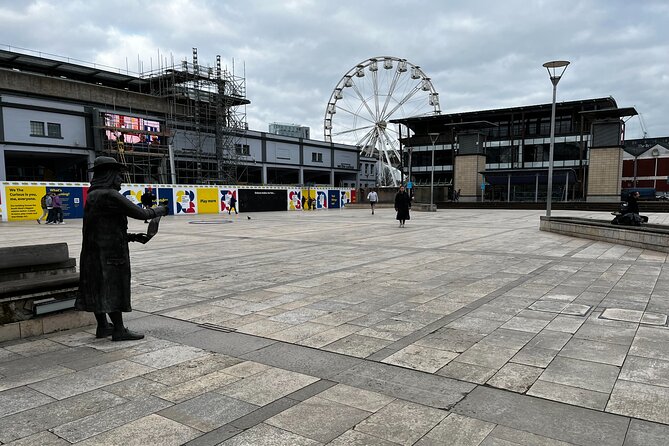
At Welsh Back, the walk shifts back toward the waterline. This area would have been busy in the past and stays busy today, especially in the evening with bars and fine restaurants. Some restaurants are on boats, which is a fun reminder that Bristol’s waterfront identity did not disappear when the docks changed.
The audio explains the unusual name, giving you the historical angle you would miss if you just treated it like a nightlife strip.
After Welsh Back, you reach Castle Park, the site of the old castle and Bristol’s medieval settlement. This stop is quick, about 5 minutes, but it is a good mental reset. You’re moving from river commerce into the older layers of settlement and power.
Bridge Quay views and the Redcliffe church rebuild
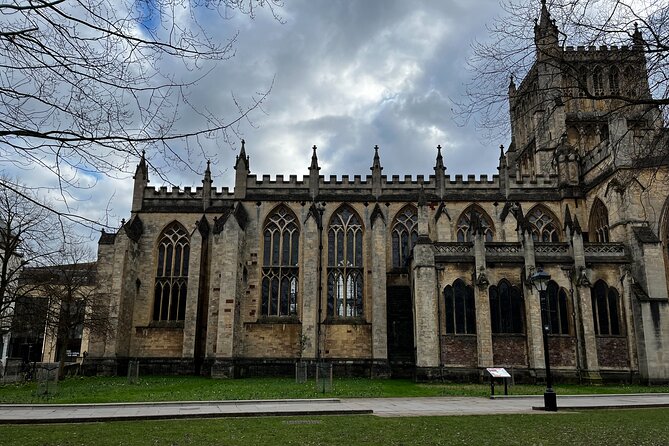
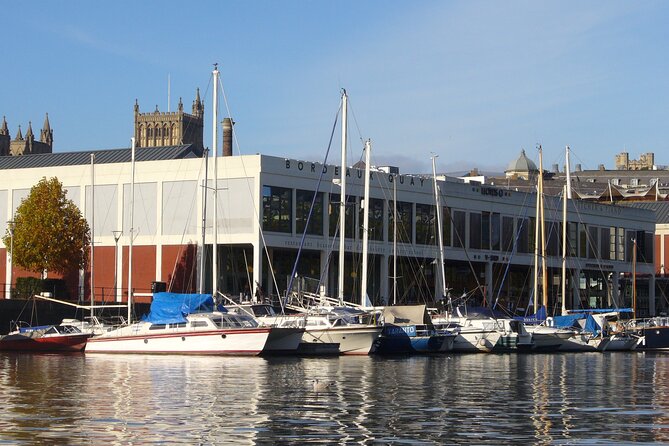
Next is Bridge Quay, where you get a good view of Bristol Bridge. With St Peter’s, St Nicholas’, and St Mary Le Port churches in the background, this is one of those “look, now I get it” spots. The audio notes that Bristol’s settlement is believed to have begun around this bridge area. Take a moment here, because later dock details connect back to this kind of anchoring point.
Then you move to St Mary Redcliffe Church in the Redcliffe area. Helen’s stories focus on what you are seeing now and how it changed. The church you see today is not the original. The earlier church from Henry I’s time fell into disrepair and was rebuilt in the 14th century.
This is a strong stop for photo lovers, but also for people who enjoy architecture and timeline thinking. You can look at the building while the story gives it a sharper meaning.
Redcliffe Caves and the dockside homes above them
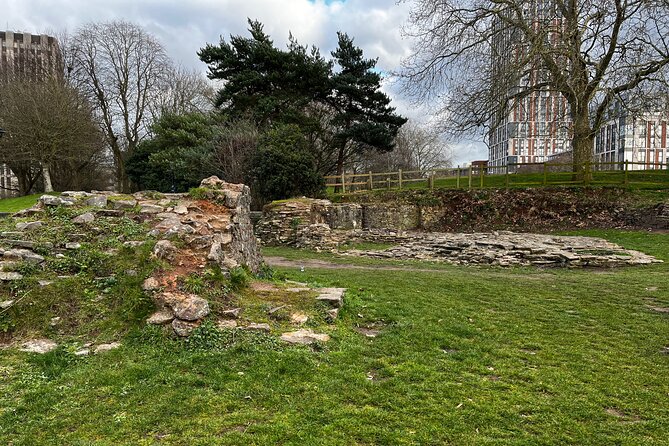
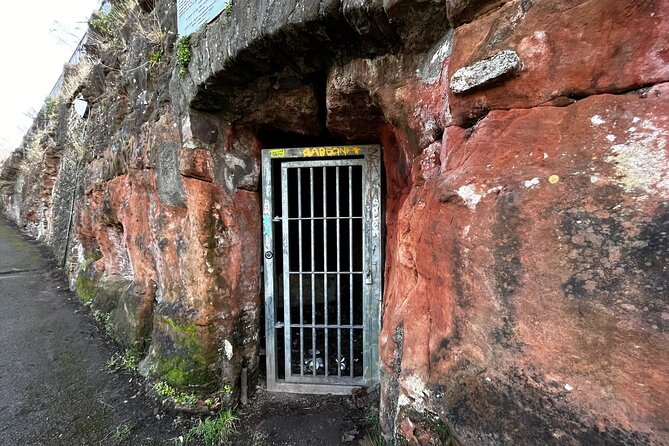
From there, you visit Redcliffe Caves. Redcliffe is named after the bright red Triassic sandstone rocks you can see from the area. The tour also points out that houses along Redcliffe Wharf are built above a cave system that leads all the way back toward St Mary Redcliffe Church.
This stop works best if you slow down. Even though it’s only about 10 minutes, the idea is big: the harbor story is not only about ships and water, it is also about the geology under the city and how people built over it.
Dock basins and working harbor logic: Bathurst Basin to Princes Wharf
Now the tour transitions into the heart of the harbor world.
You stop near Bathurst Basin, where the water supply was lost when the New Cut was dug out in 1809. The Ostrich pub at the entrance was built around 1745, and the audio connects it to sailors, dock workers, and merchants.
This is a practical kind of history. It helps you imagine how everyday people lived next to changing waterways and infrastructure.
Then you reach Princes Wharf. Most city docks are now closed to cargo ships, so today the harbor looks different from the old trading days. The tour encourages you to look closely enough to see evidence of what dock life would have been like.
It is a short stop, around 10 minutes, but it sets up the idea that the dock landscape still contains clues.
The Matthew of Bristol and finishing with Brunel
The tour includes the Matthew of Bristol, a replica of John Cabot’s ship that sailed to the Americas in 1497. The audio notes that this smaller replica ship crossed the Atlantic to Canada in 1997 to mark the 500th anniversary of Cabot’s journey.
Even if you care only slightly about transatlantic history, the inclusion is smart because it broadens the harbor story beyond local industry. Bristol is tied to big maritime movements, not just shipping crates.
After that, you stop at M Shed, a free-entry museum about Bristol. The tour gives you a reason to spend time here: it is one of the few parts of the harbourside that retains many original features, so it helps you picture the working harbor more clearly.
Finally, you move to Wapping Wharf, formerly used for shipbuilding and repair. The audio reminds you that in the 1800s Bristol Docks would have been packed with boats loading and unloading goods.
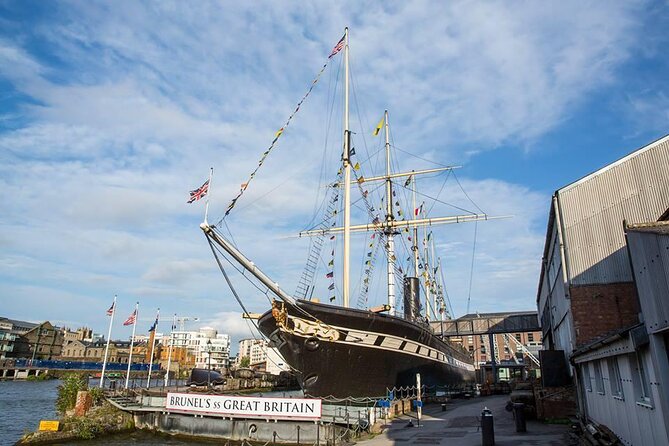
The walk’s last moments are at Brunel’s SS Great Britain area at the Great Western Dockyard. The tour notes that the ship was built by Isambard Kingdom Brunel, using iron, and was the largest ship of its kind at the time. When it launched in 1843, it was described as the greatest experiment since the creation. If you have any interest in engineering history, this end point is a satisfying payoff.
Who this self-guided harbourside walk is for
This tour is a good match if you want:
- A story-led walk without booking a live guide
- A route that stays interesting even when stops are short
- A mix of waterfront views and city squares
- Flexibility, since you can start and pause on your own time
It may be less ideal if you get easily thrown off by wayfinding, because the experience depends on following the app’s GPS directions. If you prefer a guaranteed human-led walkthrough, you may find it stressful on a busy day or if access is altered.
Most importantly, it works well for independent travelers who like to stop for photos and then move on, instead of feeling locked into a strict group pace.
Should you book this Bristol Harbourside self-guided tour?
Yes, if you want a guided-feeling walk at a low price, with Helen’s real audio and a route that connects Bristol’s rivers, squares, churches, and docks into one coherent loop. The free-to-view nature of most stops also makes it a budget-friendly way to get real mileage out of a couple of hours.
I would think twice if you hate navigation apps or you know you get impatient with detours. Plan a little extra time, keep your phone charged, and treat each stop as a quick story stop you can manage. If you do that, the walk feels like Bristol at street level, not like a hurried checklist.
FAQ
How long is the Bristol Harbourside self-guided walking tour?
The tour takes about 2 to 3 hours.
What is the price per person?
It costs $12.33 per person.
Is the tour available in English?
Yes, the tour is offered in English.
Do I get an audio guide?
Yes. Helen guides you through an audio guide, and it is described as not computer-generated.
Is there an in-person guide with the tour?
No, it is self-guided, and Helen provides the guidance through the audio guide only.
Are there admission tickets or entry fees for the stops?
The stops are listed with Admission Ticket Free. M Shed is also listed as free to enter.
Where does the tour start and end?
It starts at the Bristol central area shown by the meeting point plus code and ends at Brunel’s SS Great Britain at the Great Western Dockyard, Gas Ferry Rd, Bristol BS1 6TY.
Is it easy to reach by public transportation?
Yes, it is listed as near public transportation.
What if I need to cancel?
This experience is non-refundable and cannot be changed for any reason.
More Self-Guided Tours in Bristol
- Bristol Street Art: Banksy Exploration Game and Tour
★ 3.5 · 39 reviews - Brunel’s Bristol: A Self-Guided Tour from SS Great Britain to Clifton Bridge
★ 4.5 · 11 reviews - Secrets of Bristol Waterfront: Self-Guided Puzzle Adventure
★ 3.5 · 5 reviews - Bristol Quest: Self Guided City Walk & Immersive Treasure Hunt
★ 4.5 · 3 reviews
Recently added around Bristol
- Guided Walking Tour Suspension Bridge Clifton Splendour & City.★ 5.0 · 100 reviews
- Wine & Cheese in the Somerset Valleys – with Michelin-star lunch!★ 5.0 · 12 reviews
- Wild West Wine and Cider Experience★ 5.0 · 17 reviews
- Brunel Guided Tour in Bristol★ 5.0 · 4 reviews
- Fun, Flexible Treasure Hunt Around Bristol with Cryptic Clues & Hidden Gems★ 5.0 · 101 reviews
- Bristol’s Historic Highlights: A Timeless Journey Private Tour★ 3.5 · 3 reviews
- Tales and Legends of Lynmouth Walking Tour★ 5.0 · 13 reviews
- Brunel’s Bristol: A Self-Guided Tour from SS Great Britain to Clifton Bridge★ 4.5 · 11 reviews
Walking Tours, compared.

Oxford University Walking Tour With University Alumni Guide
Read our review →
Tour for Muggles The Ultimate Harry Potter Walking Tour in London
Read our review →
Cambridge University Walking Tour by Alumni™ Kings College Option
Read our review →
Blackbeard to Banksy – The Ultimate Walking Tour of Bristol
Read our review →
Air Raid Shelter + St. Nicholas Market Walking Tour
Read our review →
Walking Tour of Bath with Blue Badge Tourist Guide
Read our review →
Changing of the Guard Guided Walking Tour in London
Read our review →
Shadows of York: Ghost Walk and Horrible History.
Read our review →Browse the lists this tour appears in