
Reviewed · WALKING TOURS
London Mystical and Dragons Walking Tour
London’s dragons live in plain sight. This London Mystical and Dragons walking tour stitches mythology into the City of London streets, churches, and monuments, guided by Arjun with small-group attention (maximum 8). You’ll walk at a human pace, with frequent stops so the stories actually land.
I especially like the PDF take-home at the end. It turns a 2 to 3 hour walk into something you can revisit, plan around, and use later when you are wandering on your own.
One thing to consider: some churches or sites may not be open on certain days. On holidays and special days, you might get extra time at other stops and see images instead of entering a venue.
In This Review
- Key highlights you will actually care about
- First steps in the City of London’s dragon-story mindset
- Price and what you get for it
- A 2 to 3 hour walk that keeps its energy
- London Stone, the sacred anchor of the city
- Forgotten streams at Bloomberg Arcade, where the Walbrook returns
- Mithras and the hidden occult thread
- Bank of England, power over a forgotten river
- St. Mary Le Bow and the Bow Bells symbolism
- Cheapside and the oldest tree that survived the lost ones
- St. Paul’s Cathedral and the phoenix theme
- St. Martin-within-Ludgate and the feeling of ancient enigmas
- Ludgate Circus, lost rivers, and the king behind London’s name
- St Bride’s Church and the pagan-history well
- St. Dunstan In The West and medieval symbolism
- Temple Church and the Templars’ blueprint for meaning
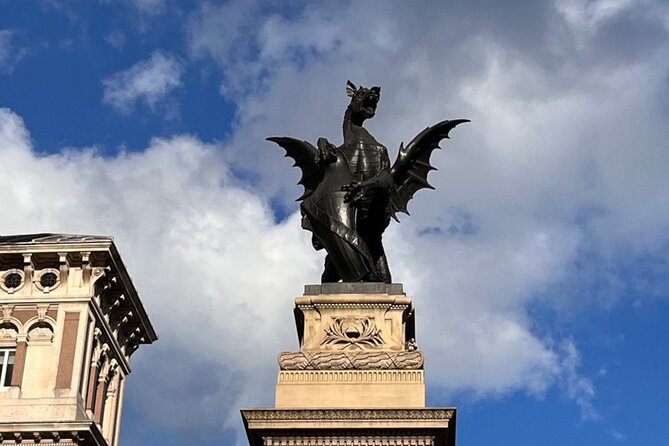
- Temple Bar Memorial, dragon guardians from Beowulf to Tiamat
- The dragon lines idea, and why the tour changes how you walk
- What you can take home: the PDF map
- When things are closed, how to handle it
- Who should book this walk
- A quick decide check: should you book it
- FAQ
- FAQ
- How long is the London Mystical and Dragons Walking Tour?
- What does the tour cost?
- What group size can I expect?
- Where does the tour start, and when?
- Where does the tour end?
- Is the tour offered in English?
- Do you get anything to take home after the tour?
- Are there paid admissions at the stops?
- Is the tour weather dependent?
- Can I cancel for a full refund?
Key highlights you will actually care about
- Small group size (max 8), so questions and personalization are realistic
- A PDF after the tour, so you can map what you saw and return later
- Dragon stories tied to real places, from London Stone to Temple Church
- Hidden-river focus, including the Walbrook and other lost waterways
- Lots of symbolic church spotting, especially in the City of London
- A satisfying ending at Temple Bar, with protector-dragon mythology
First steps in the City of London’s dragon-story mindset
Start near 113 Cannon St, London EC4N 5AW, with the meeting point by the Royal Courts of Justice. From there, you are not doing generic sightseeing. You are learning a different way to read London, where symbols, stones, churches, and even street corners get treated like clues.
The guide, Arjun, leans into storytelling without turning it into pure fantasy. The tour’s sweet spot is the in-between space: you hear myths like the London Stone keeping the city safe, then you look around and notice how the city’s power centers, waterways, and religious sites echo those stories.
You will also notice something practical. Even though it is a walking tour with multiple stops, it does not feel rushed. The format is stop-and-talk, not sprint-and-guess. That matters in the City of London, where the streets can feel busy even when you think you have escaped the crowds.
More Walking Tours in London
- Tour for Muggles The Ultimate Harry Potter Walking Tour in London
★ 5.0 · 4,684 reviews - Changing of the Guard Guided Walking Tour in London
★ 5.0 · 1,793 reviews - The Great British Rock and Roll Walking Tour
★ 5.0 · 1,371 reviews
Price and what you get for it
At about $29.48 per person for 2 to 3 hours, the value comes from the mix of guided interpretation plus a take-home resource. You are paying for the story structure, the connections between sites, and the map-like PDF that helps you keep exploring after the walk.
Another plus: the stops are marked as free-entry in the tour notes. That means you are not stacking paid admissions on top of the ticket cost. You still do plenty of looking and learning, which is the whole point here.
A 2 to 3 hour walk that keeps its energy
This is offered in English and runs roughly 2 to 3 hours. Most people can participate, and it is near public transportation. You should still plan for walking in London’s City of London area, where the ground changes, and churches can mean steps and thresholds.
Bring a good pair of walking shoes. This is one of those experiences where you will cover distance, then stop often, then cover a bit more. It feels “compact,” but your legs do work.
London Stone, the sacred anchor of the city
The tour opens at the London Stone. The legend says it is a sacred stone that keeps London safe with its presence. That is the hook, and it is a strong one because it frames everything else you see.
What you take from this stop is not just a cool story. It is the idea that London’s identity is tied to specific objects and locations. When you start looking for the “why” behind a stone, a church, or a tower, the whole walk starts making sense.
Same part of England, a different sort of day out:
- Stonehenge, Windsor Castle, and Bath from London
★ 4.5 · 18,662 reviews - London Big Bus Hop-On Hop-Off Tour with Optional River Cruise
★ 3.5 · 10,803 reviews - London Small Group Tour of Historical Pubs
★ 5.0 · 10,422 reviews - Stonehenge, Windsor Castle and Bath with Pub Lunch in Lacock
★ 4.5 · 7,402 reviews
Forgotten streams at Bloomberg Arcade, where the Walbrook returns
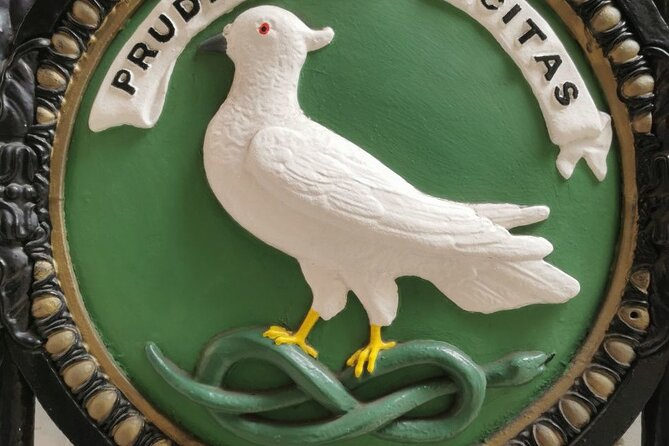
Next comes the Forgotten Streams stop at Bloomberg Arcade, where you remember the Walbrook River. In plain terms, this is the tour’s recurring theme: London grew around water, and you can still “sense” those ancient lines even after the river is gone.
The Walbrook matters because it is tied to how modern London took shape. Even if you do not go down a history rabbit hole yourself, you will walk away with a new habit: when you see streets and corners, you start wondering what used to flow there.
Mithras and the hidden occult thread
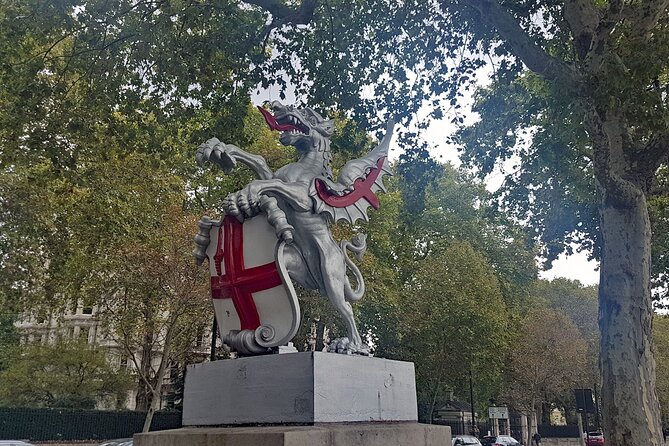
Then the tour points you toward a temple connected to Mithras, the Roman sun god. This is described as a temple that reveals ancient occult knowledge.
Even if mythology is your main interest, this stop works well because it grounds the supernatural angle in Roman-era spirituality. You are not just hearing dragon tales. You are being shown how different belief systems left traces through architecture, symbolism, and location.
Bank of England, power over a forgotten river
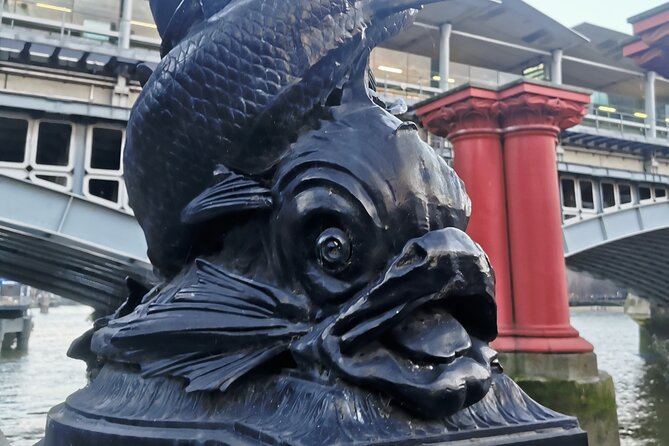
From Mithras you move to Bank of England, described as a seat of power of the City of Dragons, sitting on a forgotten river.
This is where the tour’s naming style starts to click. Dragons here are not just cute mythical creatures. They are a way to talk about guardians, city protection, hidden strength, and the layered history under the modern financial district.
You can treat this as a creative lens if you want, or you can treat it as a symbolic interpretation of how old London sits under new London. Either way, it is a good moment to pause because the area around Bank can feel very modern and very loud. The “forgotten river” idea gives you a way to look calmly instead of just rushing through.
St. Mary Le Bow and the Bow Bells symbolism
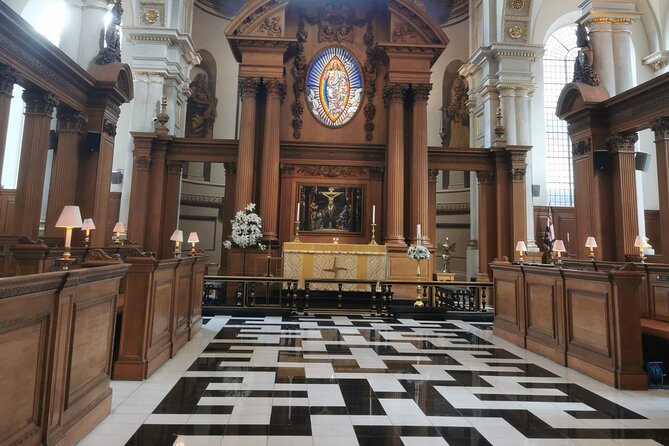
St. Mary Le Bow Church is next, with a focus on the sidelined symbolisms in the church of Bow Bells. This is one of those stops where the guide’s interpretive style really matters.
You are learning to see how church iconography can work like a coded language. Even if you do not memorize every symbol, you will notice more on your own afterward, especially the way images repeat across a city.
Cheapside and the oldest tree that survived the lost ones
In Cheapside, you get the oldest tree in the City of London and a reminder of all the trees now lost. This is a smaller emotional stop, but it is a smart one.
It changes the tour rhythm. You go from myth and architecture to something living and surviving. It also ties into the tour’s bigger point: time leaves traces. Sometimes the trace is a building. Sometimes it is a single stubborn tree.
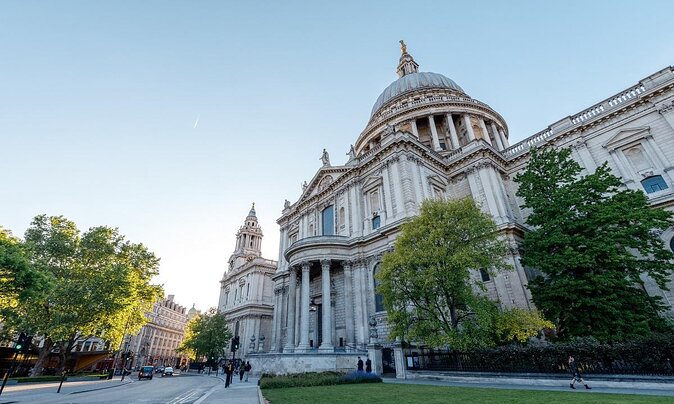
St. Paul’s Cathedral and the phoenix theme
At St. Paul’s Cathedral, the tour connects long-standing ceremony with the phoenix symbolism. This is a classic myth used in the real world, and you will hear it used here as a symbol of rebirth.
What I like about this stop is the balance. You are not only admiring a massive landmark. You are looking at it through a meaning-based filter, which makes it more than a photo stop.
St. Martin-within-Ludgate and the feeling of ancient enigmas
Church of St. Martin-within-Ludgate is described as having even more ancient enigmas. This is a good stop for people who like mystery that is grounded in place.
You are in the right part of London for this kind of vibe. The City of London can feel like it is always talking, and this stop encourages you to slow down enough to hear the older “subtext.”
Ludgate Circus, lost rivers, and the king behind London’s name
At Ludgate Circus, the theme returns: another of London’s lost rivers and the King that gave London its name. This is where mythology plus geography becomes the tour’s signature.
This stop is also a reminder that many city origin stories are part history, part legend, and part symbolic storytelling. The tour does not force you to pick a single answer. Instead, it teaches you how to notice patterns of meaning.
St Bride’s Church and the pagan-history well
St Bride’s Church brings in pagan history and mentions a well. If your interest is in “spiritual archaeology,” this is one of the standout stops.
A well is the kind of object that fits into a lot of belief systems across time. Even without getting technical, you can feel why the tour includes it. Water, sacred places, and ritual memory show up again and again in London if you start looking.
St. Dunstan In The West and medieval symbolism
St. Dunstan In The West is described as a medieval church with ancient symbolism. This stop is more quiet than some, and that is a good thing.
It gives you a moment to reset after stronger story beats. You get to absorb the feel of a medieval setting and connect it back to what you learned earlier, how symbols persist, even when the world around them changes.
Temple Church and the Templars’ blueprint for meaning
Temple Church is one of the tour’s major historical and mystical anchors. It is built by the Knights of the Templar and modeled on the Church of the Holy Sepulchre, revealing esoteric wisdom.
This stop matters for two reasons. First, the Templars were about more than swords. They were about routes, symbols, and spiritual legitimacy. Second, a modeled church is a physical clue that people intentionally recreated sacred forms in new places.
Do note one practical point, though. Temple Church has not always been open to visitors on some days. If you hit a closed-door day, you still get the story and context, but you may not get the full on-site viewing.
Temple Bar Memorial, dragon guardians from Beowulf to Tiamat
Finally, you end at the Temple Bar Memorial at the City of London end of the walk. Here, you hear about the fiercest protector dragons of the City of London.
The mythology connections go wide, including references to Beowulf, Tiamat, and St George. That broad range is part of the fun because it shows how “guardian dragon” ideas can travel through different cultures and stories, then come back in a new city costume.
The dragon lines idea, and why the tour changes how you walk
One theme that really sticks with this tour is the idea of dragon lines, routes that connect sacred places and the paths of rivers under the city.
Even if you treat this as symbolic, it is still a powerful way to explore. You start noticing how streets and buildings line up, how certain corners feel like they were meant for gathering, and how churches seem to cluster around specific kinds of memory.
This is also why the small group works. You are not just hearing a lecture. You are seeing clues while you are moving. And Arjun tends to ask questions, encourage participation, and adjust for different ages, including kids who have lots of curiosity.
What you can take home: the PDF map
You get a PDF of all the locations you saw on your tour. This is one of those “small” perks that becomes big later.
Use it like this: mark the places you want to revisit, especially the ones you photographed but did not have time to study. Then use it as a mini itinerary for a future walk, because many of these spots are close enough to stitch into another afternoon.
When things are closed, how to handle it
On some dates, churches may not be open to visitors. That includes holiday timing, and at least one stop has been reported as not open when expected. If that happens, the tour can shift time and use images as stand-ins for parts you might normally see inside.
So my advice is simple: do not plan your whole day around being inside every location. Plan for outside symbolism, guided context, and a strong storytelling thread. If you get interior access, great. If not, you still get the intended meaning.
Who should book this walk
This tour is a great fit if you:
- love folklore, mythology, and symbol hunting
- want a break from the usual London checklist
- enjoy religious buildings for meaning, not just architecture
- like the idea of hidden rivers and city layers under modern streets
- travel with teens or older kids who enjoy questions and stories
It is also a nice option if you already did the big landmarks earlier in your trip and want a fresh angle on the City of London.
A quick decide check: should you book it
Book it if you want London through a symbolic lens, with a guide who connects stories across centuries. The small group size, the PDF, and the focus on places you typically walk past make the experience feel intentional, not generic.
Skip it if you hate lots of walking, dislike churches and city symbolism, or need guaranteed interior access at every stop. The tour is weather dependent, so if your schedule is fragile, pick a day with good conditions.
FAQ
FAQ
How long is the London Mystical and Dragons Walking Tour?
It runs about 2 to 3 hours.
What does the tour cost?
The price is $29.48 per person.
What group size can I expect?
The tour has a maximum of 8 travelers.
Where does the tour start, and when?
It starts at 113 Cannon St, London EC4N 5AW, and the start time is 1:30 pm.
Where does the tour end?
It ends at the Temple Bar Memorial, City of London, London EC4A 2LT.
Is the tour offered in English?
Yes, the tour is offered in English.
Do you get anything to take home after the tour?
Yes. You take home a PDF with the locations you saw during the tour.
Are there paid admissions at the stops?
The stops are marked as Admission Ticket Free in the tour details.
Is the tour weather dependent?
Yes, the experience requires good weather.
Can I cancel for a full refund?
Yes. You can cancel up to 24 hours in advance of the experience for a full refund.
Recently added around London
- Visit the Birthplace of The Rolling Stones – Private Tour★ 5.0 · 36 reviews
- Buckingham Palace: Admission ticket to The Royal Mews★ 4.0 · 102 reviews
- The Roman City of St Albans Private Tour★ 5.0 · 8 reviews
- Discover London in Style with Your Private Blue Badge Tour Guide★ 5.0 · 7 reviews
- London Tootbus Kids Tour with Bespoke Live Guided Commentary★ 4.5 · 155 reviews
- London Hop-On Hop-Off 1-Day River Sightseeing + Painted Hall★ 4.5 · 54 reviews
- Old Royal Naval College – home to the Painted Hall, Greenwich★ 4.5 · 165 reviews
- Private Transfer London & Southampton – Cruise Terminal or Hotel★ 5.0 · 6 reviews
Walking Tours, compared.

Oxford University Walking Tour With University Alumni Guide
Read our review →
Tour for Muggles The Ultimate Harry Potter Walking Tour in London
Read our review →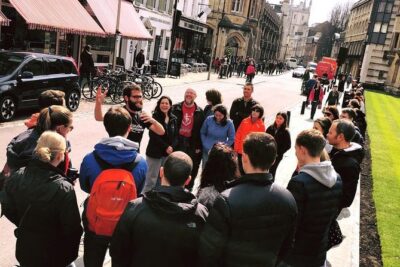
Cambridge University Walking Tour by Alumni™ Kings College Option
Read our review →
Blackbeard to Banksy – The Ultimate Walking Tour of Bristol
Read our review →
Air Raid Shelter + St. Nicholas Market Walking Tour
Read our review →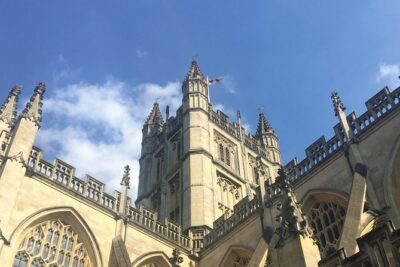
Walking Tour of Bath with Blue Badge Tourist Guide
Read our review →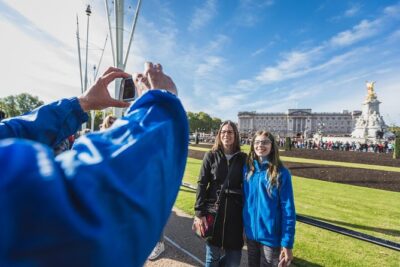
Changing of the Guard Guided Walking Tour in London
Read our review →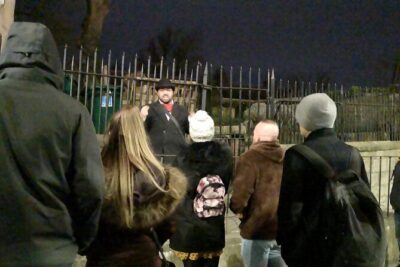
Shadows of York: Ghost Walk and Horrible History.
Read our review →Browse the lists this tour appears in