
Reviewed · WALKING TOURS
Roman London Private Walking Tour
Roman London hides under everyday streets. This private walk gives you a personal pace and a focused route to ruins you will not spot on your own. The tradeoff is simple: you need to be ready for a long, steady walk (plan for about 7 miles) and some key underground access can depend on timing.
You start near Panyer Alley and end right by Bank Underground, so the route works well in a half day. You may be guided by Kevin or Stephen, and both are praised for making Roman London feel real, answering questions, and steering you into places most people miss.
In This Review
- Key highlights
- Roman Londinium works best when you follow the streets
- Price and what you are really paying for
- Start at St Paul’s, where the Roman layer begins
- Church of St Vedast Alias Foster, and the feeling of discovery
- Noble Street to the Cripplegate area, following wall clues
- London Wall and Guildhall, where Roman London sits beside power
- The London Roman Amphitheatre, plus the most “wow” underground feel
- Bank of England to the Royal Exchange, Roman London in plain sight
- Leadenhall Market and the Gherkin area, where eras overlap
- The Tomb of the Unknown Roman Girl and London’s smaller memorials
- Vine Street museum zone, plus Trajan by the Tower
- All Hallows by the Tower and St Dunstan in the East, Roman remains inside calmer spaces
- Billingsgate Roman Bath House and St Magnus, where London still shows Roman infrastructure
- The Great Fire Monument, and the Roman London link
- London Mithraeum Bloomberg SPACE, the underground finish worth building your day around
- London Stone and the last “wait, London is that old?” moment
- What to wear, how to pace yourself, and who this tour suits
- Should you book this Roman London Private Walking Tour?
- FAQ
- FAQ
- Where does the tour start, and where does it end?
- What time does the tour begin?
- Is pickup offered?
- How long is the Roman London private walking tour?
- How much does it cost?
- Is this tour private?
- What level of fitness do I need?
- What should I wear?
- Are attraction admission tickets included?
- Can I visit the Mithras temple if it is busy?
- What if I need to cancel?
Key highlights
- Private, question-friendly guiding: You get a guide who can keep the pace and answer whatever you ask.
- Underground Roman stops: The London Mithraeum Bloomberg SPACE visit is a major highlight, with lots of artifacts before you go underground.
- Roman wall tracking through modern streets: You follow stretches of wall and gates that turn up in surprising places.
- Big-city landmarks, small-time Roman clues: Bank of England, the Royal Exchange, and Leadenhall Market all connect to Londinium.
- Parks, churches, and alleys: You see Roman remains built into later London, often around calm, photogenic spots.
- Smart logistics for London: Pickup can be arranged at a central hotel, then you use the Tube to get to the start.
Roman Londinium works best when you follow the streets
Roman London, or Londinium, is tricky because so much of it is still under your feet. The best way to understand it is not from a museum room, but by walking a line through the City, spotting fragments of wall, gates, and buildings that survived, were reused, or got buried and later rediscovered.
This tour’s big value is that it turns a scattered set of ruins into a readable story. You are not wandering from one plaque to the next. You are guided through a City route that links religious sites, defensive walls, civic buildings, markets, and entertainment venues, then ends with a strong underground finish at the Mithraeum. If you like history you can see with your own eyes, you will likely enjoy how the guide keeps connecting dots as you go.
The other practical win: the route stays in the core area, finishing near Bank Underground. That makes it easier to roll into lunch or your next stop without fighting complicated cross-city transfers.
More Walking Tours in London
- Tour for Muggles The Ultimate Harry Potter Walking Tour in London
★ 5.0 · 4,684 reviews - Changing of the Guard Guided Walking Tour in London
★ 5.0 · 1,793 reviews - The Great British Rock and Roll Walking Tour
★ 5.0 · 1,371 reviews
Price and what you are really paying for
At $254.93 per person for a 3 to 4 hour private tour, this is not the cheapest way to do Roman London. What you are paying for is one guide, your group only, and an itinerary built around specific access points and timing.
Some stops include admission, while others are free to view from public areas. You also get a guide who can take you “off the beaten path” into locations that are hard to find on your own, including places described as being below street level. That matters in London, where Roman remains are often tucked behind modern storefronts, hidden in church spaces, or partially buried under streets and later buildings.
There is also a comfort factor you should factor in. Reviews highlight a pace that feels reasonable for a long walk, but it is still real walking time. If you are hoping for a mostly stationary tour, this one may feel like work.
Start at St Paul’s, where the Roman layer begins
You begin near St. Paul’s Cathedral, starting in the shadow of a building most people treat as purely Christian. The key point here is the Roman connection: the area has a deeper past, including a Roman temple associated with the goddess Diana before the cathedral era.
From there, the tour starts doing something smart. Instead of staying at the obvious landmark, you move to the nearby edges where older layers hide. The goal is to get you to notice Roman London as a living overlap of eras, not as one sealed-off “Roman site.”
Church of St Vedast Alias Foster, and the feeling of discovery
A short hop from St Paul’s brings you to the Church of St Vedast Alias Foster, where you can see early Roman remains hidden away from the street. The tour also points out something even older in the same area, which helps you understand how long London has been reinventing the same ground.
Practical note: church interiors can be quieter and sometimes cooler than the streets. Dress smart casual, and expect to slow down a bit as you look at details.
Same part of England, a different sort of day out:
- Stonehenge, Windsor Castle, and Bath from London
★ 4.5 · 18,662 reviews - London Big Bus Hop-On Hop-Off Tour with Optional River Cruise
★ 3.5 · 10,803 reviews - London Small Group Tour of Historical Pubs
★ 5.0 · 10,422 reviews - Stonehenge, Windsor Castle and Bath with Pub Lunch in Lacock
★ 4.5 · 7,402 reviews
Noble Street to the Cripplegate area, following wall clues
Next you start tracking the Roman wall system in a way that makes the city plan click. One of the standout details here is Noble Street, where the wall was discovered thanks to Luftwaffe activity during World War II. That kind of fact turns a routine street stop into a “wait, really?” moment.
Then you move toward Cripplegate Street, tied to one of the old Roman gates of London. The value is not just the gate itself, but the nearby preserved sections of Roman city wall. These are the kinds of remnants you might walk past without context, yet with a guide they become part of a bigger map.
London Wall and Guildhall, where Roman London sits beside power
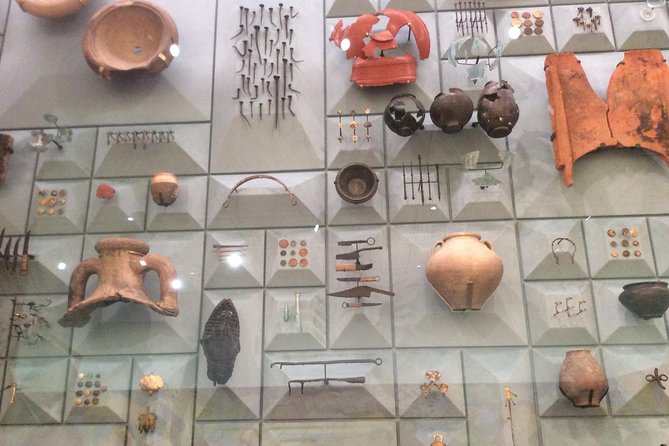
You see London Wall in multiple spots, including places that feel unexpected. That is the theme of the entire tour: Roman Londinium does not sit in a single “archaeology zone.” It is woven into later London, including areas shaped by commerce and government.
Then you reach Guildhall, a major civic building that dominates its square. The Roman connections are not the obvious headline here, so this stop works best if you have a guide to point out what to look for. There is no admission listed for this stop, so you can often take your time with exterior views and whatever you are allowed to see nearby.
If you are the type who likes understanding how old cities functioned, this is a great stretch. You are moving from defensive lines to the political heart of the City.
The London Roman Amphitheatre, plus the most “wow” underground feel
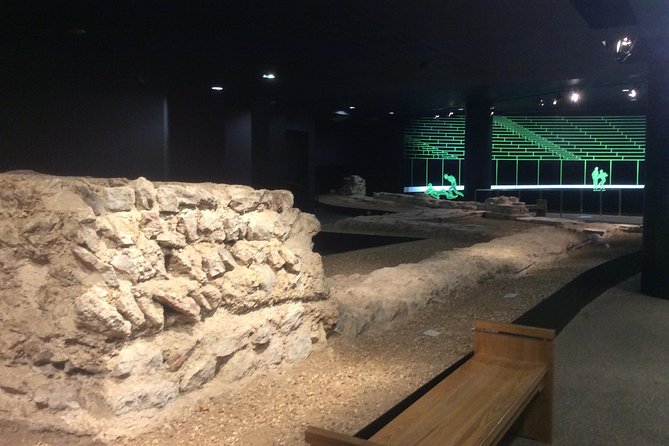
A major highlight is London’s Roman Amphitheatre. You stand in what feels like a layer of Roman London under the original streets, with the tour describing the amphitheatre as a more recent discovery. Admission is included at this stop, which helps keep things smooth.
This is the kind of stop where you start picturing crowds. Even if you only know Roman entertainment from movies, the physical framing of the site makes it more concrete. It also sets you up for the next phase: the tour increasingly moves you toward underground and “below street” experiences.
Bank of England to the Royal Exchange, Roman London in plain sight
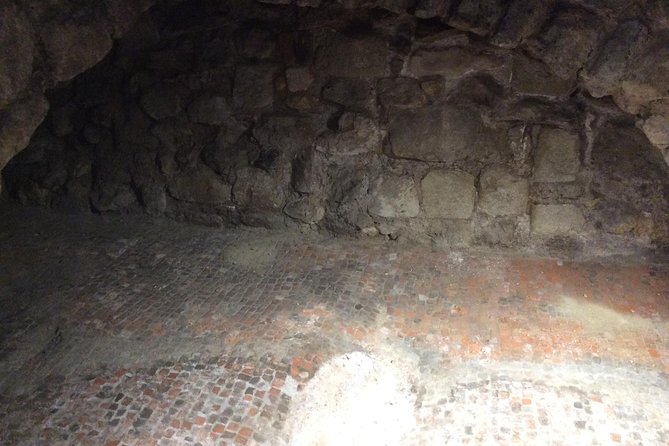
You then head toward Bank of England, described as the heart of old Roman London, framed by stone buildings that can feel overpowering. The Roman angle here is about location and continuity, not just one carved artifact.
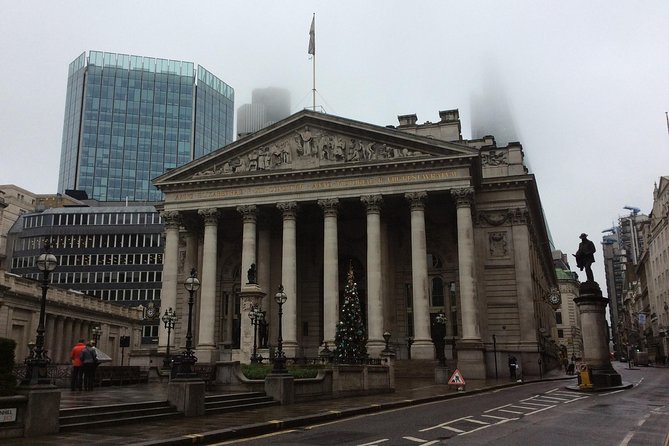
Next comes Royal Exchange Building, where the tour notes you will feel like you are in ancient Rome when you stand in front of it. Admission is included for this stop, which suggests time inside or access to a guided component tied to the building. Either way, this is a payoff stop if you like grand architecture, and also if you want Roman London connected to modern institutions.
Leadenhall Market and the Gherkin area, where eras overlap
You visit Leadenhall Market, described as a Victorian market built over its Roman predecessor. Admission is included, and the tour notes that if you are lucky, you might see a chunk of the earlier structure in a spot you might not expect. This is the kind of stop that rewards slow observation, because the Roman layer can show up where your eye is not looking first.
From there, you reach 30 St Mary Axe, better known as the Gherkin. In the shadow of that modern landmark, you find an unexpected Roman memorial. The payoff here is contrast: modern London feels sleek and new, and the Roman marker gives you a tangible reminder that the same ground has held generations of city life.
The Tomb of the Unknown Roman Girl and London’s smaller memorials
A quick stop brings you to the Tomb of the Unknown Roman Girl, described as a beautiful memorial to one of the oldest citizens of London. Even on a fast walk, memorials like this help you slow down. They also shift the story from big civic buildings to real people living inside Londinium.
Then you move to Aldgate Square, where the remains of a Roman gate are buried beneath a newly landscaped park. You can see the route of the wall and other clues nearby. This is a great example of how “hidden” does not always mean “gone.” Sometimes it means the city covered it and later shaped the surface.
Vine Street museum zone, plus Trajan by the Tower
Next is Vine Street, where the tour describes London’s newest museum area with Roman wall sections and artifacts. Admission is marked as free for this stop, so you should treat this as a quick but meaningful checkpoint. It helps you connect the earlier outdoor wall tracing with the physical objects that archaeologists have recovered.
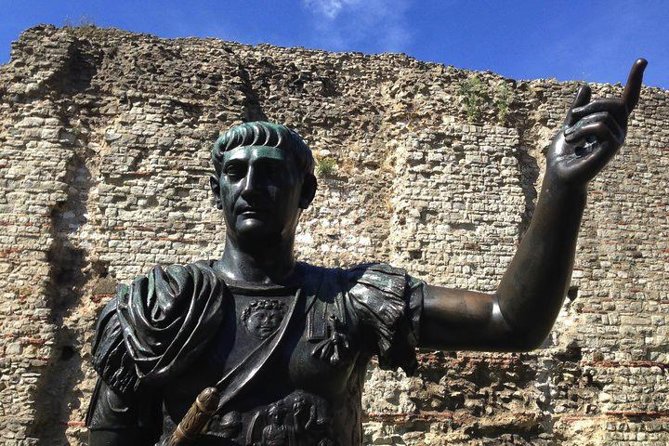
Then comes Emperor Trajan, described via a statue just outside the Tower of London. This is a short stop with a big context job: it places an actual Roman ruler into your mental timeline of Londinium.
All Hallows by the Tower and St Dunstan in the East, Roman remains inside calmer spaces
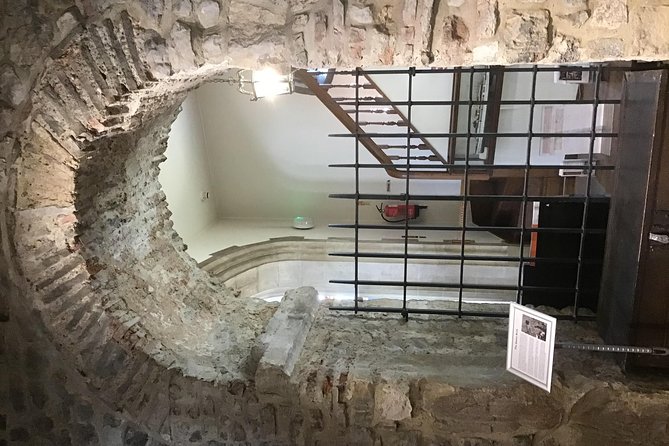
Moving through the Tower-side area, you reach All Hallows By The Tower, where the tour notes you can see the oldest archway in London as well as remains of an old Roman house. Admission is included, and the Roman thread here is a reminder that London’s religious buildings often reused older structures or sat on top of earlier foundations.
Then you go to St. Dunstan In The East, described as peaceful and specifically called out as not strictly Roman related, but considered one of the most beautiful ruins in London. Admission is included for this stop. Even if you came for Romans only, this part helps balance the day. It gives you a quiet moment after streets full of monuments.
Billingsgate Roman Bath House and St Magnus, where London still shows Roman infrastructure
Next is Billingsgate Roman Bath House, focused on the locations of the Roman baths in London. No admission is listed here. Bath sites are often harder to picture from outside because they are structural, not dramatic like an amphitheatre. A good guide helps translate what you see into how the bathing system worked and why it mattered for city life.
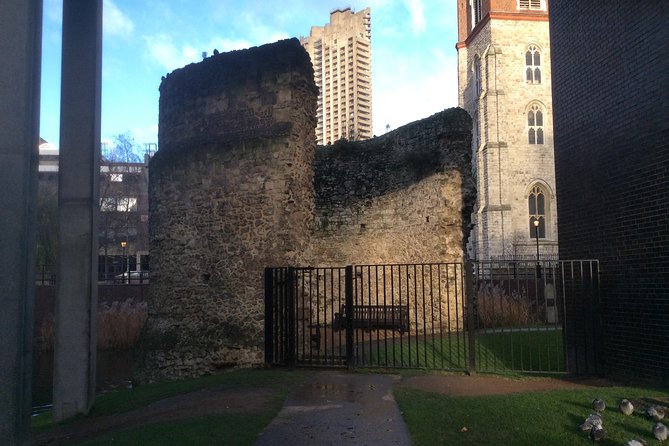
Then you visit St. Magnus The Martyr, where you are told you can find possibly the only remaining part of the original Roman London Bridge. Admission is included. Roman bridges are one of those essentials that shaped movement across the river, and it is one of the hardest things to experience in any tangible way unless you have a guide pointing you to the right remnants.
The Great Fire Monument, and the Roman London link
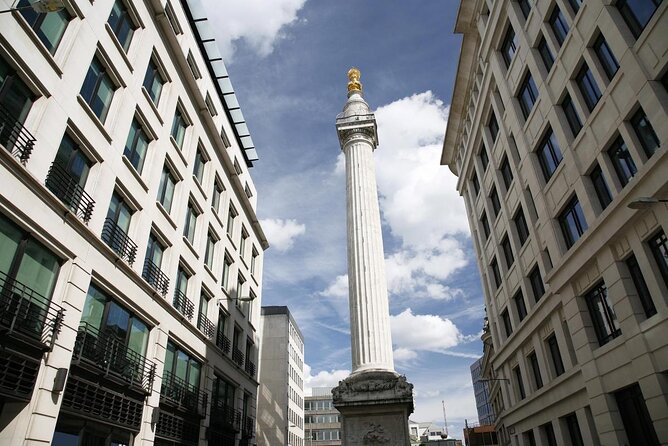
You also stop at the Monument to the Great Fire of London. The tour places you on the spot where the Great Fire started and adds visuals about Roman Londinium from 2,000 years ago in the surrounding area.
Even if you are not a deep-fire-history fan, this is a useful mental switch. It shows London’s long cycle of destruction and rebuilding. And because the area connects to Roman Londinium, it helps you understand how the city’s layers stack up, not just across centuries, but across disasters too.
London Mithraeum Bloomberg SPACE, the underground finish worth building your day around
The tour’s final major “how is this real?” stop is London Mithraeum Bloomberg SPACE. The description is clear: you see hundreds of Roman artefacts before going underground to visit the Temple of Mithras. Admission is included.
This stop is also where you should be most careful about timing. The tour info notes that guaranteed access to the temple requires advanced booking for peak times. If you are visiting during a crowded period, you should plan ahead so you are not left with an artefacts-only experience.
If you enjoy Roman religion and the idea that Londinium had multiple cultural layers, Mithras is a strong ending point. It ties together what you have been tracing all morning: Roman city life under the surface, not just Roman buildings on the surface.
London Stone and the last “wait, London is that old?” moment
You finish with London Stone, described as legendary and as old as London itself. Admission is free. This is a short, easy final stop that acts like a mental bookmark. By the time you reach it, you have already walked the wall line, stood on Roman-era street impressions, and gone underground. London Stone then feels less like a quirky sight and more like a summary of the theme you have been following.
What to wear, how to pace yourself, and who this tour suits
This is a walking tour with moderate physical fitness required. Dress code is smart casual, and the tour runs in all weather conditions, so plan for rain as well as sun. Bring water and sturdy shoes. One review notes a walk of 7 plus miles, and that matches the “3 to 4 hours” time window with steady movement.
You will likely enjoy this most if you:
- like architecture but want the story behind it
- enjoy Roman archaeology that is integrated into modern cities
- want a private guide who can adjust the pace to your questions
- are comfortable walking for hours without many long breaks
If you want a mostly museum style day, or you hate walking outdoors, this may feel like too much effort.
Should you book this Roman London Private Walking Tour?
I think you should book if your goal is to see Roman Londinium in the real City of London, including wall lines, gates, amphitheatre context, and a real underground temple visit at the London Mithraeum Bloomberg SPACE. The private format matters because the best Roman details here are the kind you only notice with a guide who can point them out.
Skip or rethink it if you are not up for a steady multi-hour walk, or if you are visiting during peak times and you do not want to manage advanced booking for temple access. Otherwise, it is a strong value choice for anyone who wants Roman London to feel connected, not random.
FAQ
FAQ
Where does the tour start, and where does it end?
The tour starts at Panyer Alley, London EC2V 6AA and ends at London Mithraeum | Bloomberg SPACE, 12 Walbrook, London EC4N 8AA. It also ends right by Bank Underground Station in central London.
What time does the tour begin?
The listed start time is 9:30 am.
Is pickup offered?
Yes. Pickup is offered at central London hotels, not only the listed start point. The guide then goes by Tube to the tour starting point.
How long is the Roman London private walking tour?
It runs 3 to 4 hours (approx.).
How much does it cost?
The price is $254.93 per person.
Is this tour private?
Yes. It is a private tour, and only your group participates.
What level of fitness do I need?
The tour requires moderate physical fitness. Plan for a steady walking day.
What should I wear?
The dress code is smart casual. Since it operates in all weather conditions, dress for rain and wind too.
Are attraction admission tickets included?
Some are included and some are not. For example, London Roman Amphitheatre, Royal Exchange Building, Leadenhall Market, 30 St Mary Axe area items, St Magnus The Martyr, All Hallows By The Tower, St. Dunstan In The East, London Wall (one visit labeled included), and London Mithraeum Bloomberg SPACE are marked as admission included. St. Paul’s Cathedral, Billingsgate Roman Bath House, and others are marked as not included.
Can I visit the Mithras temple if it is busy?
The tour info says guaranteed access to the temple requires advanced booking for peak times.
What if I need to cancel?
You can cancel for free up to 24 hours in advance for a full refund. Changes made less than 24 hours before the start time are not accepted.
Recently added around London
- Shared Service from Stansted airport to Central London★ 3.5 · 3 reviews
- VIP Private Transfers Stansted Airport to/from Any London Hotel★ 5.0 · 6 reviews
- Transfer from London Stansted Airport to Central London★ 5.0 · 6 reviews
- eSIM for UK (34 EU countries) | 3 to 30 days. Up to 40GB of data★ 4.0 · 18 reviews
- Layover Tour of London from LHR Executive Luxurious Vehicle Private Tour 6 hour★ 4.5 · 9 reviews
- Working Women of the East End Walking Tour★ 5.0 · 85 reviews
- York Day Rail Tour from London Including Hop-on Hop-off Tour★ 3.0 · 3 reviews
- London with a Local (Historical)★ 5.0 · 3 reviews
Walking Tours, compared.

Oxford University Walking Tour With University Alumni Guide
Read our review →
Tour for Muggles The Ultimate Harry Potter Walking Tour in London
Read our review →
Cambridge University Walking Tour by Alumni™ Kings College Option
Read our review →
Blackbeard to Banksy – The Ultimate Walking Tour of Bristol
Read our review →
Air Raid Shelter + St. Nicholas Market Walking Tour
Read our review →
Walking Tour of Bath with Blue Badge Tourist Guide
Read our review →
Changing of the Guard Guided Walking Tour in London
Read our review →
Shadows of York: Ghost Walk and Horrible History.
Read our review →Browse the lists this tour appears in