Reviewed · LONDON TOURS
Royal Observatory Greenwich & Prime Meridian Entry Ticket London
Greenwich turns timekeeping into something you can actually stand on. I love the feeling of being east and west at once when you step into the Meridian Courtyard. I also love that the visit is built around real instruments and stories, from Harrison’s longitude clocks to the Great Equatorial Telescope.
One thing to plan for: you climb a steep hill to reach the observatory, and some parts are not fully accessible.
In This Review
- Key highlights you will feel right away
- Entering the Meridian Courtyard at Royal Observatory Greenwich
- Flamsteed House walkthrough: where astronomers worked and explained
- The Octagon Room and Sir Christopher Wren details
- Harrison’s clocks, the longitude story, and public time
- The red Time Ball from 1833, still doing its job
- Great Equatorial Telescope in the onion dome
- Views and weather: how to plan around the steep walk
- Pair it with the nearby UNESCO Maritime Greenwich free sights
- Price and value: what $33.90 really buys you
- The main catch: access, stairs, and how to decide confidently
- Should you book this Royal Observatory and Prime Meridian entry?
- FAQ
- How long does the Royal Observatory Greenwich and Prime Meridian entry take?
- What is the price for this entry ticket?
- Is there an audio guide included?
- What language options are available?
- Where do you start inside the attraction?
- What are the main things you can see during the visit?
- Are National Maritime Museum and Queen’s House included?
- Is public transportation nearby?
- Are service animals allowed?
- Who can enter for free and what about children?
- Can I cancel for a refund?
Key highlights you will feel right away
- Prime Meridian photos in the Meridian Courtyard, where you literally straddle east and west
- Audio guide on your phone so you can pace your own visit and tune out the crowd noise
- Harrison’s clocks and longitude history tied to inventions that changed daily life
- Time Ball signals from 1833, including the bright red ball still used to mark the time
- Great Equatorial Telescope inside the iconic onion dome for classic astronomy at full scale
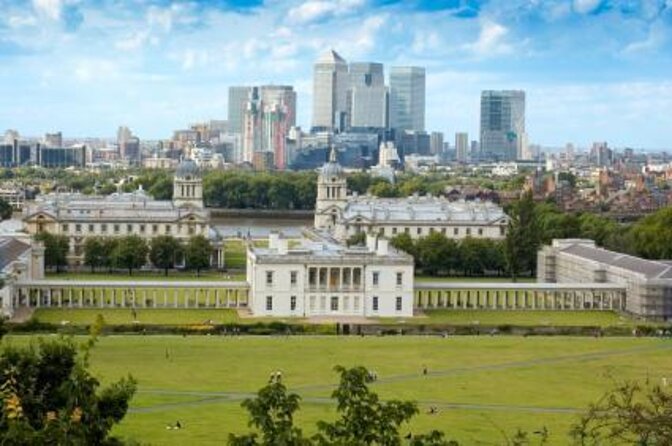
- Big views from Greenwich Royal Park over the City of London and the River Thames
Entering the Meridian Courtyard at Royal Observatory Greenwich

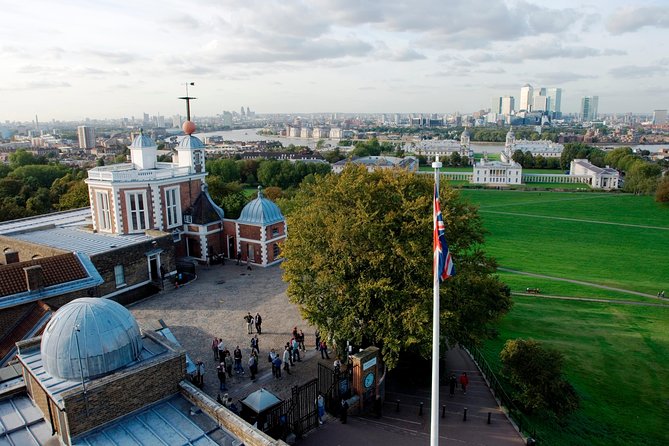
The Royal Observatory sits on a hill in Greenwich Royal Park, so even before you reach the main buildings, you get that London-in-a-breeze feeling. Expect dramatic views over the City of London and the River Thames, with the whole area laid out for walking. If you like sightseeing with a sense of purpose, this is one of the rare stops where the location and the topic match perfectly.
Your visit begins in the Meridian Courtyard. This is the moment you came for: you stand astride the Prime Meridian Line, with one foot in the east and the other in the west. It is simple, physical, and very photo-friendly. The best part is that it is not just a marker. It is tied to the practical work of setting time, measuring the world, and syncing navigation.
I also appreciate how the museum approach supports different interests. If you want astronomy, it has tools and domes. If you want history, it has clocks and public time signals. And if you just want to understand why GMT matters, the audio guide keeps the pace manageable.
A few more London days worth comparing
- Stonehenge, Windsor Castle, and Bath from London
★ 4.5 · 18,662 reviews - London Big Bus Hop-On Hop-Off Tour with Optional River Cruise
★ 3.5 · 10,803 reviews - London Small Group Tour of Historical Pubs
★ 5.0 · 10,422 reviews
Flamsteed House walkthrough: where astronomers worked and explained
After the courtyard photo moment, you move through the story of how the observatory earned its reputation. Flamsteed House is one of the key stops. This is where you walk in the footsteps of the Astronomers Royal, not in a vague way, but with exhibits that connect people to specific achievements.
This section works well because it keeps answering the same big question: how did humans learn to measure time accurately enough to navigate and coordinate life? You will see the timeline of discoveries associated with major names, including Harrison, Newton, Halley, Bradley, Maunder, Airy, and Einstein. The list is a reminder that timekeeping and astronomy are not separate worlds. They overlap constantly.
A practical tip: audio guides are a huge help here. You can listen at your own speed while other visitors move past the exhibits. One review highlighted that the audio system helped make it easier to hear when busier groups were nearby, and that makes sense in a place where everyone is trying to photograph, read, and listen at once.
The Octagon Room and Sir Christopher Wren details
One of the most rewarding interiors is the Octagon Room, designed by Sir Christopher Wren. It is described as one of the best preserved Wren interiors in London, and you will notice it quickly when you step into the space. It adds a calm, architectural layer to a site that otherwise can feel very technical.
Why this part matters: it helps the observatory feel like a living institution, not just a set of displays. The room gives you a sense of scale and permanence, which makes the science stories land harder. When you learn about instruments like clocks and telescopes, it helps to be in a place that reflects careful design.
If you are the type who gets tired of reading walls of text, this is still worth slowing down for. Interior spaces like this give your eyes a break, and they make the whole visit feel less like a checklist.
Harrison’s clocks, the longitude story, and public time
The observatory is famous for timekeeping, and the exhibits spell out why that was world-changing. The highlight for many visitors is Harrison’s clocks, tied to inventions that helped change navigation and everyday life. Even if clocks are not your hobby, you can usually follow the logic: better time measurement means better positioning and safer travel.
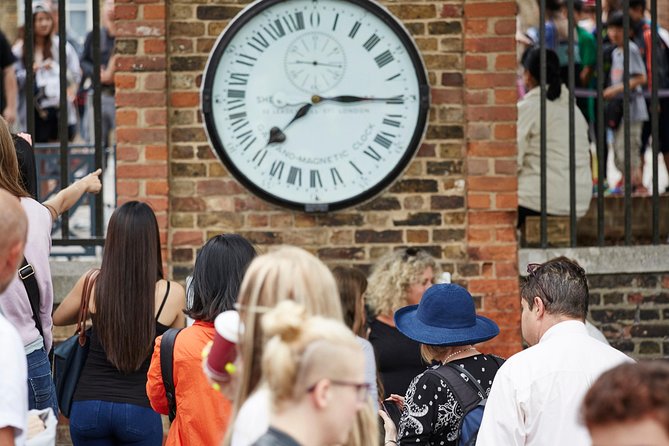
You will also see the Shepherd Gate Clock mounted outside. It is described as the first clock to show Greenwich Mean Time to the public. That single fact is worth sitting with. It turns GMT from a scientific idea into something that ordinary people could use.
I like this section because it does not treat timekeeping as trivia. It connects time to real outcomes. When you see how public clocks emerged from scientific work, you start understanding why a line on the ground in Greenwich mattered to ships, rail schedules, and coordination long before phones existed.
Same part of England, a different sort of day out:
- Stonehenge, Windsor Castle and Bath with Pub Lunch in Lacock
★ 4.5 · 7,402 reviews - Tower of London and Crown Jewels Exhibition Ticket
★ 4.5 · 6,677 reviews - Thorpe Park Admission Ticket
★ 4.0 · 5,915 reviews - Stonehenge, Windsor Castle and Bath Full Day Guided Tour
★ 4.5 · 5,346 reviews
The red Time Ball from 1833, still doing its job

One of the most memorable visual signals is the bright red Time Ball on top of Flamsteed House. It was first used in 1833, and it still operates today. That is a rare thing in museums: an object that is both historical and functional.
What I find smart about this is that it turns time into a visual event. A clock face is abstract. A time ball is a shared moment. People can look up at the same instant and get the same message, which is exactly how time signals used to work before everyone carried the same device.
If you are visiting with kids or anyone who learns best by seeing, this is an easy win. It also makes a great photo, especially if you time your visit so you can catch the operational moment.
Great Equatorial Telescope in the onion dome
Astronomy fans usually perk up at the Great Equatorial Telescope. It is located in the huge iconic onion dome, and it is described as giving astronomers new views of the universe over 100 years ago.
This is not a hands-on science lab. It is more like classic cinema set dressing, but for real instruments. The point is scale and context. Even without deep technical knowledge, you can feel what this represented: a big leap in how people could observe the sky.
If you are worried about being out of your depth, do not. The audio guide helps you connect what you are seeing to why it mattered. If you are naturally curious, this stop tends to keep momentum high because it feels like you are standing inside the history of observation.
Views and weather: how to plan around the steep walk
A recurring theme is that the climb up to the observatory is steep. You are walking uphill from Greenwich Royal Park, and it can be a deal breaker for some people. Even if you are fit, it is smart to wear good shoes. If rain hits, it can also slow you down and make the outdoor walking parts less comfortable.
One review flagged that a rainy day can spoil the experience because there is a lot to walk outdoors. I agree with the logic. If you can pick your day, aim for fair weather. If you cannot, bring a waterproof layer and plan extra time so you do not feel rushed.
Crowds can build fast. One review mentioned getting in early as gates opened, then taking the line photo right away before the area got busy. That is solid advice for anyone who cares about getting clear photos without fighting the flow.
Pair it with the nearby UNESCO Maritime Greenwich free sights

The observatory sits in the UNESCO World Heritage Site of Maritime Greenwich, and you get a strong add-on opportunity. The National Maritime Museum and the Queen’s House are within a short walk and are free to visit.
This is a great value combo because you pay once for the observatory entry, then you can expand your day without another ticket cost. Even if you do not want to spend hours in every building, you can use these nearby free sights to stretch your time in Greenwich and make the overall trip feel more complete.
I also recommend adding Cutty Sark if your schedule allows. It is described as the world’s sole-surviving tea clipper, now an award-winning museum and visitor experience. Even if you do not go inside, the ship is a recognizable Greenwich anchor.
Price and value: what $33.90 really buys you
At $33.90 per person for about a 2 hour visit, this is priced like a top-tier attraction in central London. The value comes from the fact that you are not just paying for one static exhibit. You are paying for access to a cluster of timekeeping milestones, including the Meridian Courtyard, landmark rooms, clocks, public time signals, and major astronomy equipment.
The audio guide is a key part of why it feels worth it. It is free to download and available in English, with multiple languages offered. That gives you control over your pacing and makes it easier to learn even if the site layout and crowds limit how much you can read.
Book ahead. This attraction is described as always popular, and the average booking window is about 35 days in advance. If you wait until you arrive, you risk losing the time slot you want, or spending time hunting tickets when you could be learning.
The main catch: access, stairs, and how to decide confidently
The good news is that the main experience is doable for most people. The caution is that certain parts are not fully accessible, and the hill to the top involves serious walking and stairs.
One review was blunt about accessibility, noting steep terrain, limited lift options outside, and no internal lifts. Another review simply said the climb was longer than expected. Taken together, the safest takeaway is this: if mobility is an issue, plan before you go. The site itself notes that some areas are not fully accessible, and you should contact the attraction if you need help planning.
If you are traveling with strollers, older relatives, or anyone who tires quickly on hills, you might still enjoy it, but build the outing around the climb. Start early, keep your breaks short, and consider pairing the observatory with more level Greenwich walking afterward so you do not end the day exhausted.
Should you book this Royal Observatory and Prime Meridian entry?
Book it if you want a London stop that feels both iconic and practical. You are getting a physical world landmark, a clear connection to GMT and how time became public and navigational, and classic instruments like Harrison’s clocks and the Great Equatorial Telescope. The audio guide makes the educational value easier to access without turning it into a text-heavy slog.
Skip or rethink it if the steep walk and stairs are a hard no for you, because accessibility is limited and the climb is real. Also, if you only have a short window and hate hill walks, you might prefer a more flat Greenwich plan and just do the surrounding sights.
If you do book, go with a mindset of slow curiosity. Give yourself time to stand at the Meridian, watch for the time signal details, and then wander just enough to let the science stories connect in your head. Greenwich is great when you stop rushing.
FAQ
How long does the Royal Observatory Greenwich and Prime Meridian entry take?
The visit is listed as approximately 2 hours.
What is the price for this entry ticket?
The price is $33.90 per person.
Is there an audio guide included?
Yes. A free audio guide download is included, available in 10 different languages.
What language options are available?
English is offered, and the audio guide has multiple language options. The on-site audio guide is also described as available in 7 languages.
Where do you start inside the attraction?
Your visit begins in the Meridian Courtyard at the Prime Meridian Line.
What are the main things you can see during the visit?
You can see the Prime Meridian Line, Flamsteed House, the Octagon Room designed by Sir Christopher Wren, Harrison’s clocks, the Shepherd Gate Clock, the Time Ball, and the Great Equatorial Telescope in the onion dome.
Are National Maritime Museum and Queen’s House included?
Admission to the National Maritime Museum and Queen’s House is not included because they are free to visit, and they are within short walking distance.
Is public transportation nearby?
Yes, it is listed as near public transportation.
Are service animals allowed?
Yes, service animals are allowed.
Who can enter for free and what about children?
Children under 4 years are free to enter the attraction, and children must be accompanied by an adult.
Can I cancel for a refund?
Yes. Free cancellation is available if you cancel up to 24 hours in advance for a full refund. Changes made less than 24 hours before the experience start time are not accepted.
Recently added around London
- Stonehenge Private Tour★ 5.0 · 4 reviews
- Private Transfers From Heathrow Airport to Central London★ 5.0 · 8 reviews
- Professional Private Couple Photoshoot★ 5.0 · 35 reviews
- Private transfer to Southampton with a stop at Stonehenge★ 4.5 · 33 reviews
- Private transfer from London Heathrow Airport to Southampton★ 5.0 · 3 reviews
- Private London Panoramic Tour by Car with Pick Up From Your Hotel★ 5.0 · 13 reviews
- Private Transfer Any London Hotel to Southampton Cruise Port★ 5.0 · 7 reviews
- Private driver tours to Leeds Castle, Canterbury, White Cliffs★ 4.5 · 30 reviews
London Tours, compared.

Stonehenge, Windsor Castle, and Bath from London
Read our review →
London Big Bus Hop-On Hop-Off Tour with Optional River Cruise
Read our review →

Stonehenge, Windsor Castle and Bath with Pub Lunch in Lacock
Read our review →
Tower of London and Crown Jewels Exhibition Ticket
Read our review →
Stonehenge, Windsor Castle and Bath Full Day Guided Tour
Read our review →
Windsor Castle, Stonehenge, and Oxford Day Trip from London
Read our review →