
Reviewed · HISTORICAL TOURS
Jane Austen’s Bath And History Trail
Jane Austen walked these Bath streets. This 2.5-hour trail threads her time in town through Bath’s biggest sights, with stops that range from Georgian crescents to medieval Abbey walls. You end up understanding why Bath mattered to her writing, not just memorizing names and dates.
I love the free entry to the Jane Austen Centre as part of the walk. I also like the small group size (max 10), which makes it easier to ask questions as you’re moving between buildings.
One thing to weigh: some highlights are outdoors and the walk can include uneven ground and uphill stretches. Also, major museum entries like No. 1 Royal Crescent are not included, so you may want to plan your extra spend if you want to go inside.
In This Review
- Key Highlights You Should Not Miss
- Why This 2.5-Hour Jane Austen Walk Feels Like a Shortcut to Bath
- Meeting at Pulteney Bridge, Then Getting Your Bearings Fast
- Pulteney Bridge to Great Pulteney Street, Plus a Plaque at Sydney Place
- The Jane Austen Centre Stop: Free Entry and Time for the Shop
- Royal Crescent and Bath Abbey: Two Big “Mood” Makers
- Thermae Bath Spa, Ancient Springs, and Austen at No. 13
- The Circus and Assembly Rooms: Regency Social Life in Architecture Form
- Roman Baths and the Pump Room: Where Bath Literature Gets Specific
- Price and Value: What $40.24 Gets You, and What You May Still Pay For
- Practical Tips That Make the Walk Easier
- Should You Book the Jane Austen Bath And History Trail?
- FAQ
- How long is the Jane Austen Bath And History Trail?
- What does the tour cost?
- Where do I meet the guide?
- Is the Jane Austen Centre included?
- Are museum entrance fees included?
- What language is the guide?
- Is there a lot of walking?
Key Highlights You Should Not Miss
- Ulrich Wenske’s pacing, with a relaxed feel and time for questions even when the weather turns
- Jane Austen Centre stop with free entry, plus time to visit the shop
- Austen-linked architecture moments, including plaques and “look at it this way” street-level context
- Bath Abbey details like its long restoration story and famous memorials and wall plaques
- Roman Baths plus Pump Room context, tied back to the novel Northanger Abbey
Why This 2.5-Hour Jane Austen Walk Feels Like a Shortcut to Bath
Bath is the kind of city that rewards slow wandering. But if you only have a half day, this tour gives you structure without turning into a checklist. In 2 hours 30 minutes, you cover several of the most defining Bath looks, while a guide connects them back to Austen’s life and the city’s “why this mattered” story.
The real value is that you don’t just get directions. You get interpretation: how Bath’s streetscape, social scene, and landmark buildings show up in what Austen was writing and how she lived. That’s the difference between seeing monuments and actually getting a sense of the place.
More history tours in Bath:
- Bath: Local Pubs & Historic Sights Walking Tour (3h)
★ 5.0 · 31 reviews - London Small Group Tour of Historical Pubs
★ 5.0 · 10,422 reviews - Soho Music & Historic Pubs Tour
★ 5.0 · 1,993 reviews
Meeting at Pulteney Bridge, Then Getting Your Bearings Fast
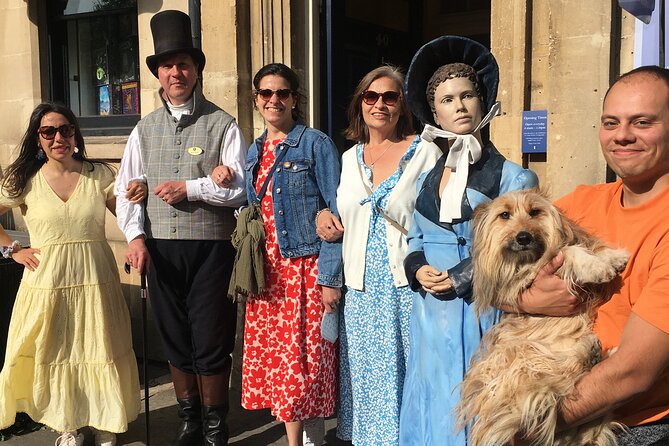
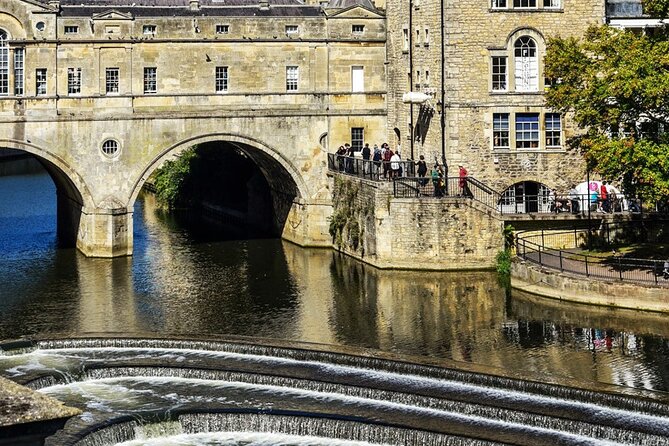
You start at the Pulteney Bridge Coffee Shop, number 17 Pulteney Bridge in Bath. This is a good choice because Pulteney Bridge sits right at the heart of your first “wow” moment, with shops along both sides and a strong sense of perspective.
A practical note: some promotional photos can make the Jane Austen Centre look like the start. Don’t count on that. The meeting point is on Pulteney Bridge, so if you’re using a map, plug in the address for the coffee shop location and arrive a few minutes early.
The tour ends back at the same meeting point. That keeps your day simple, especially if you’re planning lunch nearby or want to continue exploring on your own right after.
Pulteney Bridge to Great Pulteney Street, Plus a Plaque at Sydney Place
The first stop is Pulteney Bridge, designed in 1769, and known for its line of shops. It’s also where the tour sets the tone: walk a little, look closely, and learn why the architecture matters.
From there, you continue along Argyle Street and make time for Great Pulteney Street and nearby landmarks like Laura Place and the area around Great Pulteney Street. You’ll also get a clear view of the Holburne Museum of Art from this general area, which helps you picture how Bath’s cultural institutions sit right inside the classic city streets.
One detail I appreciate here is the street-level Austen link. You can look toward No. 4 Sydney Place, where a name plaque marks Austen’s first dwelling in Bath. You’re not just told she lived somewhere, you’re shown where that memory sits in the city today.
If you’re interested, you can also take a walk toward the Holburn Museum from this area. Admission is not part of the tour, but it’s an easy add-on if you want more arts and architecture on the same side of town.
The Jane Austen Centre Stop: Free Entry and Time for the Shop
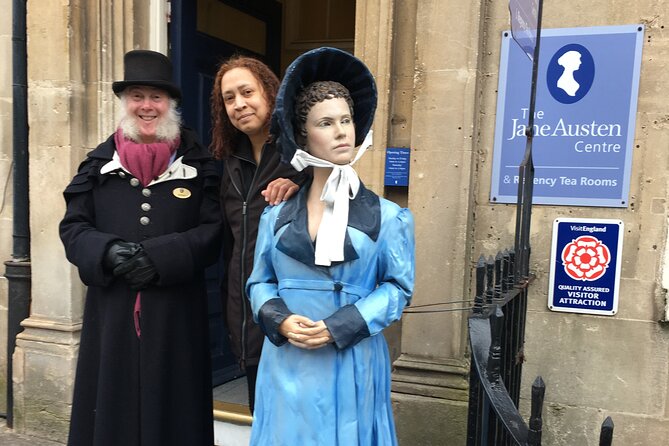
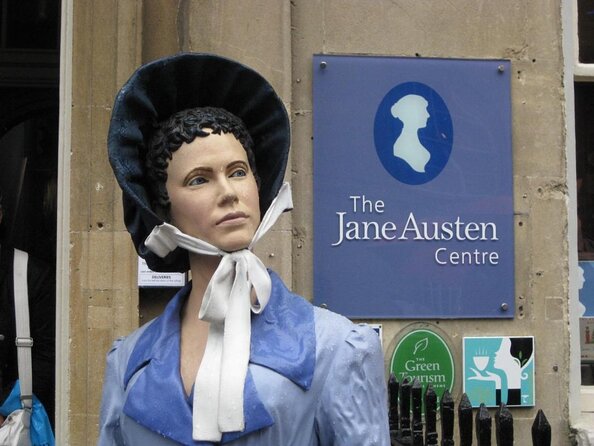
The walk then brings you to the Jane Austen Centre, Bath’s major Austen-focused stop. Here’s where the tour earns points for value: the tour includes free entry to the centre and you get to visit the book shop.
Inside, the centre offers a snapshot of Regency life and connects it to Bath’s role in Austen’s life and writing. Even if you don’t plan to add every possible internal add-on (separate guided tours inside the centre can be booked), you’ll still leave with a clearer sense of the era.
You get about 20 minutes at this stop, which is enough time to orient yourself, scan the main displays, and browse the shop without losing the flow of the outdoor walking portion.
A few more Bath days worth comparing
- Walking Tour of Bath with Blue Badge Tourist Guide
★ 5.0 · 1,877 reviews - Stonehenge, Avebury & the Cotswolds from Bath (Small group)
★ 5.0 · 798 reviews - Roman Baths and Bath City Walking Tour
★ 4.5 · 762 reviews - Fully Guided Bath Ghost Tours
★ 5.0 · 539 reviews
Royal Crescent and Bath Abbey: Two Big “Mood” Makers
Next up is No. 1 Royal Crescent, one of Bath’s most photographed backdrops. You’ll see the grand Georgian Crescent structure with its terraced houses and the large Ionic columns, and you’ll learn why it became such a symbol of 18th-century status.
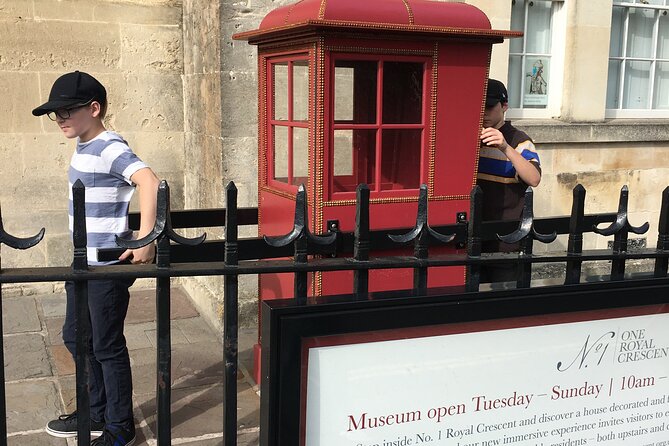
There’s an important budgeting reality here. The No. 1 Royal Crescent museum entry is not included. That said, even standing outside and hearing what you’re looking at helps. And if you do want to go inside, you’ll be deciding based on your interests rather than being surprised by extra costs mid-tour.
After that, you move to Bath Abbey. This is one of those places where the stones have stories. The Abbey’s timeline is part of the tour explanation: construction began in the early 12th century, and Bishop Oliver King started restoration in 1499. Completion came later under Elizabeth I in 1611. You also hear about memorials and wall plaques, plus a standout historical note: the crowning of Edgar I in 977.
You also have the option to visit the Abbey interiors. Again, that’s not bundled into museum-style admission as part of the tour price, so your best approach is to decide on the spot once you see how much time you still have and whether your feet are ready for indoor exploring.
Thermae Bath Spa, Ancient Springs, and Austen at No. 13
This part of the tour is a reminder that Bath is not only about history, it’s about the city’s signature water story. You’ll learn about the only place in Britain where you may swim in natural thermal water, with a rooftop pool that sits at about 35 degrees Celsius and is open in summer and winter.
The springs behind the water are explained too, including the Hetling Spring, Cross Spring, and King’s Spring, with origins described as going back 10,000 years. Whether you actually plan to swim or just want to understand the science of Bath’s thermal reputation, this stop adds a layer most Austen-themed walks skip.
Right after the thermal-water focus, you also get Austen-linked context tied to her short residence at No. 13 in 1799. The value here is perspective. Austen’s time in Bath stops being a vague “she lived there once” fact and becomes a specific point you can connect to the city’s social geography.
The Circus and Assembly Rooms: Regency Social Life in Architecture Form
The Circus is a highlight for a reason. You learn it was designed by John Wood architects, inspired by their interest in prehistoric stone circles and modeled to emulate the Coliseum in Rome. Work began in 1754, and the building’s form helps explain why Bath’s elite life felt so staged, so ceremonial, and so architectural.
You also get a chance to explore the site in a way that makes it more fun than a photo stop. One practical tip: try the acoustics mentioned by the guide’s style and what you can experience around the Circus. It’s one of those moments where the city performs back at you.
Then you move to the Assembly Rooms. These were central to public socializing and the ball rooms of Regency society. The stop includes the ballrooms, an octagon, and card room and tea room spaces that still host events.
Here’s what I like about including Assembly Rooms in an Austen-focused itinerary: it directly supports the idea of Bath as a social machine. If you want to understand what Austen was observing, the room layouts and public spaces matter. They show you how people gathered, displayed themselves, and moved through social rituals.
Roman Baths and the Pump Room: Where Bath Literature Gets Specific
The tour finishes with the Roman Baths area, the city’s main landmark dating to the 1st century AD. You’ll see the Roman temple of Sulis Minerva and the pools tied to the historic water site.
The guide also recommends booking audio tours for the Roman Baths separately before or after the walk. That’s a good call because it lets you manage your time: you can get the big orientation with the guide, then go deeper at your pace with audio if you want more interpretive detail.
Afterward, you’re pointed toward the Pump Room, described as a symbol of Bath’s Georgian golden age. The Pump Room is where the fashion-conscious elite gathered for balls, tea, and the ritual of taking the waters.
This is where the literary tie-in becomes more than a fun fact. The tour connects the Pump Room to Jane Austen’s novel Northanger Abbey, noting that Catherine and Isabelle often met there. If you read Austen and wondered why Bath feels so “social,” this is the kind of clue that makes the book feel more real.
Price and Value: What $40.24 Gets You, and What You May Still Pay For
At about $40.24 per person for roughly 2.5 hours, this walk is priced for people who want smart orientation and story-based sightseeing. The tour includes a multilingual guide (English or German), and you get a mobile ticket.
The highest value piece for many people is the free Jane Austen Centre entry and access to the book shop. That alone turns a typical outdoor walking tour into something with indoor context.
What you should budget separately is entrance fees for museums and certain interiors, including No. 1 Royal Crescent. If you’re the type who loves inside views, plan a little extra. If you prefer to keep costs controlled, you can still get a lot from the walk, the street-level Austen markers, and the citywide landmark explanations.
Practical Tips That Make the Walk Easier
This is a walking tour, and the guide’s pacing matters. From the way the tour is described, you should expect time outside in open air, plus occasional steps and some uphill stretches. Wear comfortable shoes, and if you’re traveling in warmer months, bring water.
Weather also matters. The tour requires good weather, but when weather is poor, the guide has options to shelter and even shift to a virtual style approach if needed, so you’re not left feeling stranded.
One more practical thought: because the group size is capped at 10, you’re likely to get a more personal experience than you would with a larger bus-style group. If you arrive late, the guide style is to look for you rather than just starting without you, but don’t test that. Arrive a few minutes early, especially if you’re navigating a busy central area.
Should You Book the Jane Austen Bath And History Trail?
Book it if you want a tight, story-driven introduction to Bath that connects architecture and social life to Austen’s time. It’s especially worthwhile if you like walking through real neighborhoods and picking up specific Austen-linked markers, not only famous buildings.
Skip or think twice if you want a “museums included” package. No. 1 Royal Crescent and other interior visits are not included, so you’ll likely decide on the spot whether you want to pay extra. Also, if you dislike walking and steps, treat the uphill stretches as a real factor.
If you’re someone who plans travel days around specific sights, this tour is a solid spine for your afternoon. You’ll get bearings fast, and you’ll know where to go next on your own.
FAQ
How long is the Jane Austen Bath And History Trail?
It runs about 2 hours 30 minutes.
What does the tour cost?
The price is $40.24 per person.
Where do I meet the guide?
You meet at Pulteney Bridge Coffee Shop 17 Pulteney Bridge, Bath BA2 4AY, UK. The tour ends back at the meeting point.
Is the Jane Austen Centre included?
Yes. The tour includes entering the Jane Austen Centre free of charge and visiting the book shop. Internal guided tours inside the centre are not included.
Are museum entrance fees included?
No. Entrance fees for museums are not included, including No. 1 Royal Crescent.
What language is the guide?
The guide is multilingual, offered in English or German.
Is there a lot of walking?
Yes, it is a walking tour. Wear comfortable shoes, and expect some uphill stretches and steps.
Recently added around Bath
- Private Day Tour from Bath to Stonehenge and Salisbury with Pickup★ 5.0 · 9 reviews
- Private Day Tour from Bath to Glastonbury and Wells with Pickup★ 5.0 · 14 reviews
- Private Day Tour from Bath to the Captivating Cotswolds★ 5.0 · 51 reviews
- Jane Austen Self-Guided Audio Walking Tour in Bath★ 4.0 · 4 reviews
- Private Cotswolds tour from Bath★ 5.0 · 12 reviews
- Lacock and Castle Combe – Afternoon Private Tour★ 5.0 · 55 reviews
- The ‘Hidden Cotswolds’ Shared Tour from Bath for 2-8 people★ 5.0 · 83 reviews
- Medieval Bath: A Self-Guided Audio Tour along the City Wall★ 4.5 · 3 reviews
Historical Tours, compared.


Shadows of York: Ghost Walk and Horrible History.
Read our review →
A Walk Through Time: History of Liverpool Walking Tour
Read our review →
Royal Historic Pubs Walking Guided Tour in London
Read our review →
Private Group: Historical Pub Walking Tour of London
Read our review →
Best Of Liverpool Heritage, History & Culture Guided Walking Tour
Read our review →Browse the lists this tour appears in