
Reviewed · HISTORICAL TOURS
Roman Ruins to Blitz Bombings: A Walking Tour of London’s Fiery History
London tells its story in burned layers. In this two-hour walking tour, you connect Roman-era traces, the Great Fire, and WWII damage through major City landmarks, guided by Tom’s clear, story-driven way of explaining what you see.
I especially like the small-group size (max 15). It makes the walk feel personal, and you can actually ask questions without the guide shouting over you. I also like the pace, with short, well-timed looks at each site plus side comments that help you keep the timeline straight.
One thing to consider: it is still a full walk. If you have mobility limits, you may find it tough, since the tour is designed to cover a lot of ground in a short time.
In This Review
- Key highlights you should know
- A Tight 2-Hour Timeline from Roman Traces to the Blitz
- Where You Start at Trinity Square and Finish by Ye Olde Cheshire Cheese
- Tower of London: Royal Power in Your First Five Minutes
- St Dunstan in the East: Medieval Gardens After WWII
- The Great Fire Stop at the Monument, Plus London Stone Legends
- Bank of England Museum and Guildhall: City Power, Past to Present
- St Paul’s Cathedral: A Landmark You See Even If You Skip Inside
- Why Tom’s Storytelling Works for First-Timers
- Price Check: Does $27.78 Make Sense Here
- Quick Prep Tips So the Walk Feels Easy
- Should You Book This Fiery History Walking Tour?
- FAQ
- How long is the walking tour?
- What is the cost per person?
- How large is the group?
- Where do I meet and where does it end?
- Is admission included for the stops?
- What language is the tour offered in, and do I get a ticket?
- Is free cancellation available?
Key highlights you should know
- Tom’s storytelling links Roman clues to later shocks like the Great Fire and WWII damage.
- Seven stops in about two hours means quick, focused time at each place.
- Some big admissions are not included, so you can choose what to pay for.
- Two stops are free (St Dunstan in the East and London Stone), helping you keep costs down.
- Maximum 15 people keeps the vibe from feeling rushed or crowded.
A Tight 2-Hour Timeline from Roman Traces to the Blitz
This is a London walk built like a timeline you can feel in your feet. The route takes you through layers of the city’s past, from Roman-era leftovers you can spot in the area (including pointers to free museums with Roman ruins and artifacts) to later events that literally changed the landscape.
What makes it work is the way the guide ties each stop to the next one. You do not just see famous names, you learn what kind of power lived there, what got destroyed, and what came back in a different form. That helps a first-time visitor get oriented fast, and it helps repeat visitors notice stuff they usually walk past.
You also get real human moments from the guide. Based on how Tom handles questions, you can expect an interactive style, not a lecture. One nice bonus: Tom also tends to share suggestions after the tour, so you can build the rest of your day instead of guessing.
More History Tours in London
- London Small Group Tour of Historical Pubs
★ 5.0 · 10,422 reviews - Soho Music & Historic Pubs Tour
★ 5.0 · 1,993 reviews - Royal Historic Pubs Walking Guided Tour in London
★ 5.0 · 803 reviews
Where You Start at Trinity Square and Finish by Ye Olde Cheshire Cheese
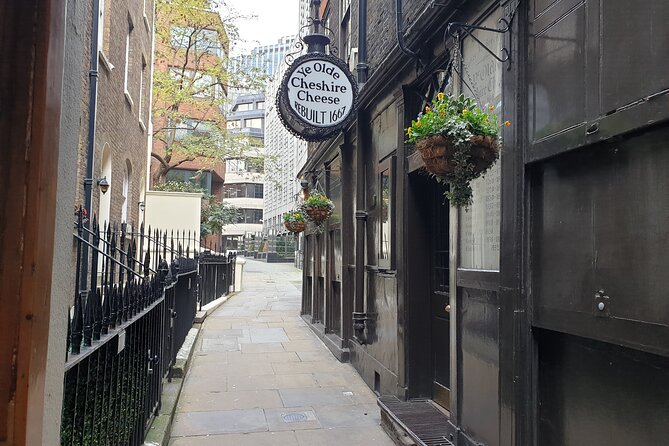
You meet at 38 Trinity Square, London EC3N 4DJ, and you end outside Ye Olde Cheshire Cheese, 145 Fleet Street, London EC4A 2BP. The finish point is not far from Blackfriars Station, which makes it easy to tack on lunch, pub time, or your next stop.
The tour is designed to be convenient in the real world. It is near public transportation, and the day runs close to a simple, walkable route through central London. You also get a mobile ticket, and you receive confirmation at booking time.
One more practical detail: Historic London Tours runs this with a maximum of 15 travelers, so you are not fighting a crowd. With a small group, your pace matches the guide’s, and you can hear the explanations without constant faceplant into someone else’s umbrella.
Tower of London: Royal Power in Your First Five Minutes
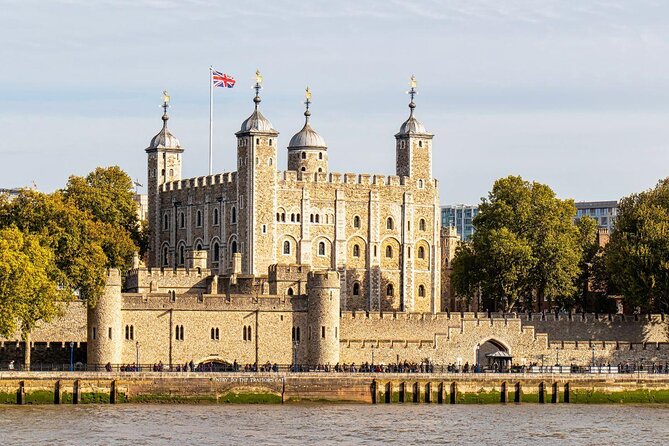
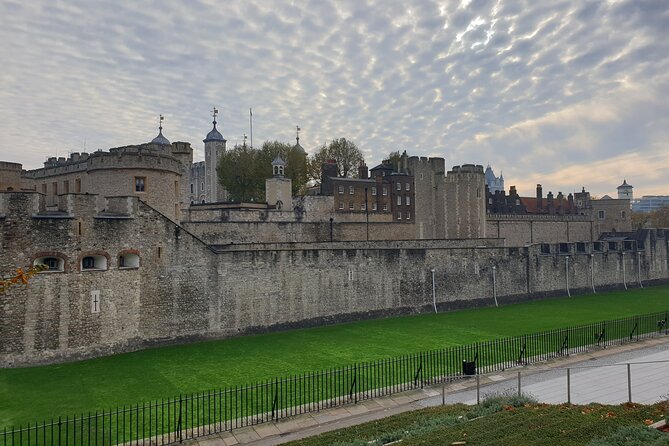
The tour starts at the Tower of London, described as Europe’s oldest surviving royal palace. Even if you do not go inside, the exterior setting immediately tells you this is not just pretty stone. It is a statement about authority, defense, and how the city protected itself.
Your stop here is short, about five minutes, and admission is not included. That is good for two reasons. First, you can treat it like an orientation stop, then decide later if the full ticket is worth it for you. Second, it keeps the walking tour from becoming a fee marathon.
What I like about this opening is how it sets the tone. You start with royal power, then move into a route where destruction and rebuilding keep showing up. It makes later stops feel connected, not random.
St Dunstan in the East: Medieval Gardens After WWII
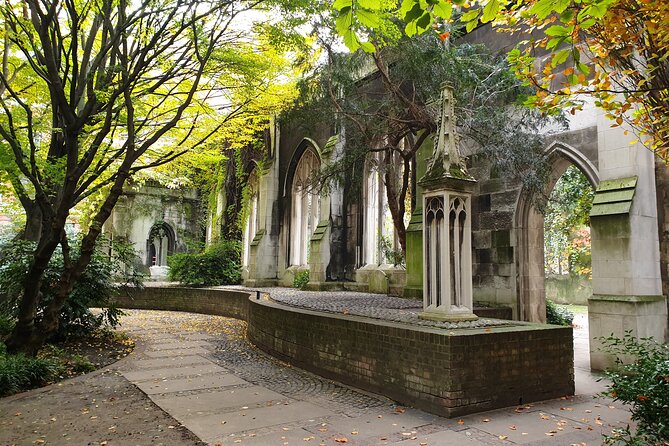
Next up is St Dunstan in the East. This stop is free and focuses on a simple, painful idea: a medieval church that was destroyed during the Second World War, now marked by gardens where the past meets the damage.
The emotional effect here is real, but the tone does not turn into doom. In a good guide hands, this kind of history becomes understandable. The guide’s job is to make you see the layers without forcing you to recite dates.
You get about five minutes here too, so treat it like a pause. Look, absorb, then move on. If you want longer time inside the story, you can always return later on your own. But as part of a two-hour walk, it keeps the tour focused.
More Walking Tours in London
- Tour for Muggles The Ultimate Harry Potter Walking Tour in London
★ 5.0 · 4,684 reviews - Changing of the Guard Guided Walking Tour in London
★ 5.0 · 1,793 reviews - The Great British Rock and Roll Walking Tour
★ 5.0 · 1,371 reviews - Westminster Guided Walking Tour with Abbey Entry
★ 5.0 · 1,282 reviews
The Great Fire Stop at the Monument, Plus London Stone Legends
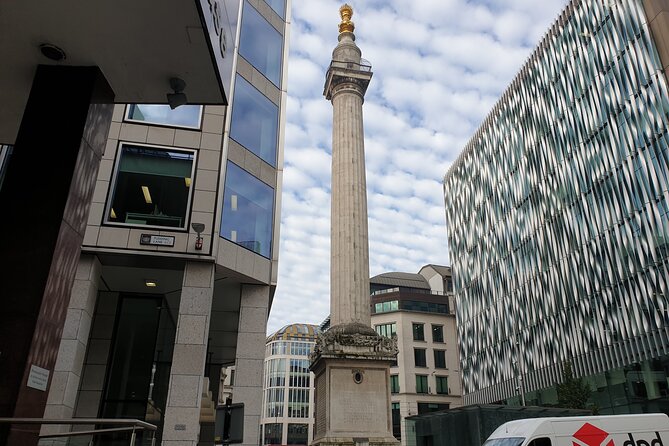
The walk then hits the Monument to the Great Fire of London from 1666. Admission is not included, but the stop is still worthwhile because the guide frames what the Great Fire meant for the city’s later shape.
Right after that, you reach the London Stone, a small object with big mythology attached. Admission is free here, and that matters because it gives you a “fun with facts” stop. You learn the legends people associate with it, and you start to see how London identity is built from stories as much as buildings.
A nice part of this segment is variety. One stop is a memorial tied to catastrophe. The other is almost playful, a legendary anchor in daily life. Together they show how London records its past, sometimes with monuments, sometimes with rumor and tradition.
Bank of England Museum and Guildhall: City Power, Past to Present
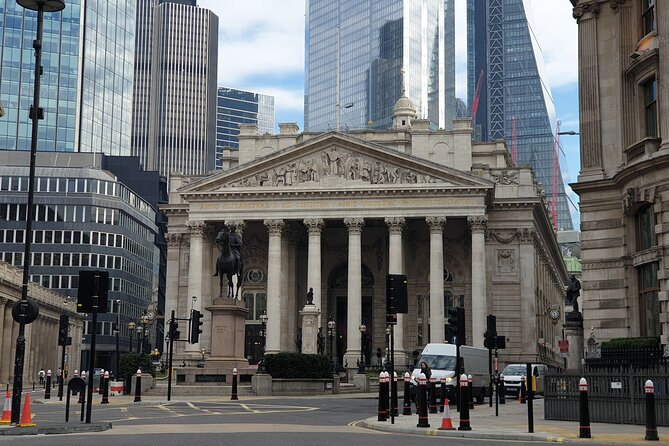
Now you shift from visible landmarks to institutional muscle. The Bank of England Museum is next, and admission is not included. This is the “how the system works” stop in the middle of the walk. You do not have to treat it like a museum visit right then. Even a short look and a clear explanation can make you understand why the Bank belongs in a history tour.
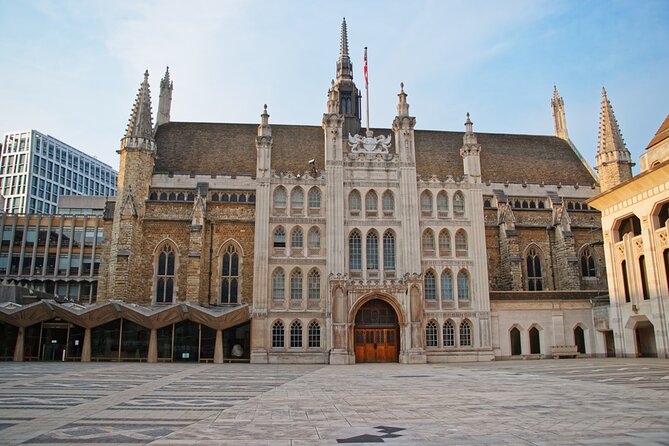
Then comes Guildhall, a 15th century hall and home to the Corporation of London. Admission is not included, but the point is the setting. Guildhall represents the civic face of the City, where decisions get made and history becomes policy.
This is also where you feel the advantage of a small group. The guide can answer the practical questions people usually hold back, like how these institutions relate to the street-level London you just walked through.
St Paul’s Cathedral: A Landmark You See Even If You Skip Inside
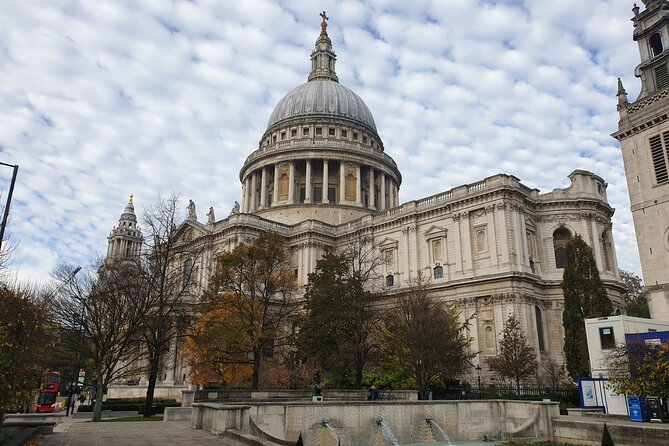
The final stop is St Paul’s Cathedral, described as Christopher Wren’s seventeenth century cathedral. Admission is not included, but you still get the payoff of seeing one of London’s most recognizable shapes in a route that has already talked about disaster and survival.
What I like here is the way the tour gives you a context frame. After learning how earlier events reshaped the city, St Paul’s feels less like a postcard and more like a response. You end with a landmark that makes the whole walk feel like it has a finish line.
This stop is also about five minutes, so treat it as a visual landing point. If you want to go inside later, you will already know why it matters in the larger story.
Why Tom’s Storytelling Works for First-Timers
The standout feature here is the guide, and the name that shows up in the feedback is Tom. The recurring theme is simple: he has deep knowledge, but he shares it in an approachable way.
You can expect clear explanations, a steady flow of information, and the kind of pacing that does not drown you. One review said they liked not being hit with too much at once, and that matches what you want on a two-hour walk. You want memorable points, not a data dump.
Tom also seems comfortable with questions. That matters because London history is full of confusing names and overlapping eras. When your guide can answer enthusiastically and clearly, the walk becomes more than sightseeing. It becomes a fast way to build a mental map of the city.
If you are the type who likes to plan your next steps, you may also get solid suggestions after the tour, based on what you are interested in.
Price Check: Does $27.78 Make Sense Here
At $27.78 per person, this is not a throwaway add-on. It is priced like a guide-led walking experience that expects you to value context and storytelling more than unlimited admissions.
Here is the value equation that matters:
- You pay for a guided route with a small group.
- Some major sites require tickets (Tower of London, the Monument, Bank of England Museum, Guildhall, St Paul’s Cathedral).
- Two stops are free (St Dunstan in the East, London Stone), which helps offset out-of-pocket costs.
So if you already plan to see any of the ticketed sites, this tour becomes a strong primer. You will walk in with a storyline in your head. If you do not plan to pay for interiors, you can still get value from the exterior stops and the guide’s connections.
Also, this type of tour is often booked ahead. On average it is booked about 37 days in advance, so if you want a specific day, it is worth locking it in sooner rather than later.
Quick Prep Tips So the Walk Feels Easy
Because the stops are short and the route is tight, you should prep like this is a concentrated city walk, not a slow stroll.
Wear comfortable shoes. You are moving between central sights, and the tour is designed around quick looks. Bring a water bottle if you tend to get thirsty while walking.
If you have mobility issues, take the warning seriously. One comment flagged it as not recommended for anyone with mobility concerns. Even if you can manage short stops, the main challenge is the continuous walking time in a compact window.
If you rely on transit, you are in luck. The tour is near public transportation, and the start and end points both work well with common routes through central London. Service animals are allowed, which is helpful for people who need that support.
Should You Book This Fiery History Walking Tour?
Book it if you want a guided London timeline that connects Roman traces, the Great Fire, and WWII impacts without needing to plan six separate museum days. The max 15 group size and Tom’s question-friendly style are the kind of details that can turn a basic “see the sights” day into a better understanding of how the city evolved.
Skip it or think twice if you need a low-movement option. This is a walking tour with multiple quick stops and continuous travel between them. Also, if you want fully included museum time at the big names, note that admissions for major sites are not included.
If you like history you can picture in place, and you enjoy a guide who keeps the information clear without overwhelming you, this one is an easy yes.
FAQ
How long is the walking tour?
The tour lasts about 2 hours.
What is the cost per person?
The price is $27.78 per person.
How large is the group?
This experience has a maximum of 15 travelers.
Where do I meet and where does it end?
You start at 38 Trinity Square, London EC3N 4DJ. The tour ends outside Ye Olde Cheshire Cheese, 145 Fleet Street, London EC4A 2BP.
Is admission included for the stops?
Admission is not included for several stops, including the Tower of London, the Monument to the Great Fire of London, the Bank of England Museum, Guildhall, and St Paul’s Cathedral. St Dunstan in the East and London Stone are listed as free.
What language is the tour offered in, and do I get a ticket?
The tour is offered in English and you get a mobile ticket.
Is free cancellation available?
Yes. You can cancel for a full refund up to 24 hours before the experience start time.
Recently added around London
- Stonehenge Private Tour★ 5.0 · 4 reviews
- Private Transfers From Heathrow Airport to Central London★ 5.0 · 8 reviews
- Professional Private Couple Photoshoot★ 5.0 · 35 reviews
- Private transfer to Southampton with a stop at Stonehenge★ 4.5 · 33 reviews
- Private transfer from London Heathrow Airport to Southampton★ 5.0 · 3 reviews
- Private London Panoramic Tour by Car with Pick Up From Your Hotel★ 5.0 · 13 reviews
- Private Transfer Any London Hotel to Southampton Cruise Port★ 5.0 · 7 reviews
- Private driver tours to Leeds Castle, Canterbury, White Cliffs★ 4.5 · 30 reviews
Historical Tours, compared.


Shadows of York: Ghost Walk and Horrible History.
Read our review →
A Walk Through Time: History of Liverpool Walking Tour
Read our review →
Royal Historic Pubs Walking Guided Tour in London
Read our review →
Private Group: Historical Pub Walking Tour of London
Read our review →
Best Of Liverpool Heritage, History & Culture Guided Walking Tour
Read our review →Browse the lists this tour appears in