
Reviewed · CANTERBURY TOURS
The Canterbury Classic Tour
Canterbury tells better stories when you walk it. This 1.5-hour guided loop takes you past the big names and the odd little details, with a capped group of 10 and a guide who turns streets into scenes.
What I like most is the way the tour mixes famous Canterbury anchors (think Chaucer and Thomas Becket) with surprising side-stories, including the kind of strange symbolism that makes you look twice. One thing to plan for: a few stops have optional entry fees (some are free, some aren’t), so your total out-the-door cost may vary.
In This Review
- Key highlights you will feel fast
- Getting Oriented in Canterbury, Without Starting at the Cathedral
- Meeting at the Beaney House and Setting Yourself Up for a Good Walk
- Stop 1: The Chaucer Statue, and the City’s Storytelling Hook
- Stop 2: Westgate Towers, the Medieval Gate Built for Fight and Escape
- Stop 3: Marlowe Theatre and How Written Power Shows Up in Modern Buildings
- Stop 4: Christ Church Gate, and the Tudor Prince You Might Not Expect
- Stop 5: Roman Canterbury Clues, WWII Rediscovery, and Butchery Lane Oddities
- Stop 6: St Thomas of Canterbury RC Church, Thomas Becket, and the Dove in the Ear
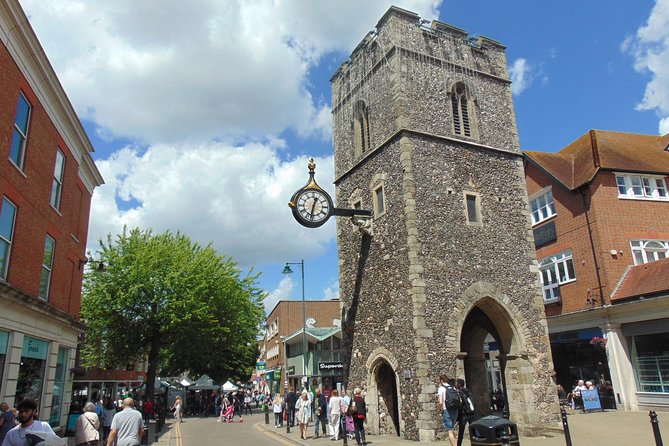
- Stop 7 and the Finish: Saint George’s Tower and the Clock That Anchors Today
- Price and Value: Why This 19-Dollar Walk Feels Like More
- Who This Tour Suits Best (and Who Might Find It Less Useful)
- Practical Tips for Getting the Most From Your 90 Minutes
- Should You Book the Canterbury Classic Tour?
- FAQ
- Is admission included for every stop?
- How long is the Canterbury Classic Tour?
- How many people are in the group?
- Where does the tour start and end?
- Is the tour offered in English, and do I need a paper ticket?
- What is the cancellation policy?
Key highlights you will feel fast
- Max 10 people means you can actually ask questions and keep a real conversation going
- Mobile ticket makes it easy to show up and start right away
- Quirky Canterbury details show up repeatedly, from weird clock locations to strange dove symbolism
- A tight route covers centuries in about 90 minutes, without the usual tourist wandering
- Flat, compact city makes a walking tour feel manageable, even on a cool day
Getting Oriented in Canterbury, Without Starting at the Cathedral
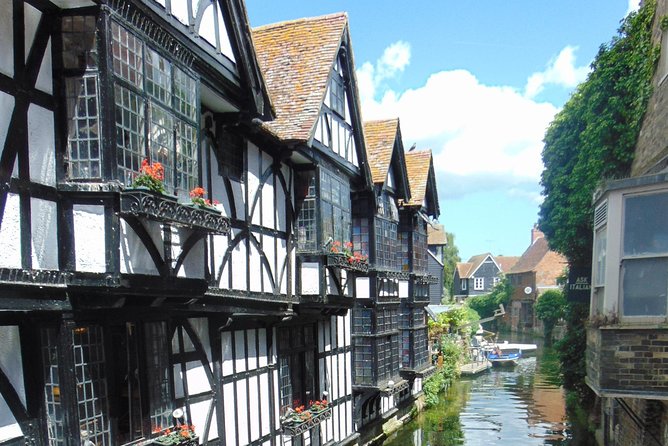
Canterbury can feel like two cities at once. There is the headline draw, the Cathedral and church history. Then there are the streets, shopfronts, lanes, gates, and towers that quietly carried the city through Roman times, medieval chaos, and wartime rediscovery.
That is why this tour works so well early in your trip. You are not just sightseeing. You are learning how to read the city. After about 90 minutes, you stop seeing buildings as background and start seeing them as clues. The group stays small, and that matters. When you hear a story about a gate, you can ask what happened nearby, or why the architecture looks the way it does, without being rushed or lost in a crowd.
I also like the pace. It is slow enough to absorb details, but brisk enough that you do not feel stuck. The flat and compact feel of the center helps too, so the walking does not turn into a punishment.
A few more Canterbury days worth comparing
- Official Canterbury Guided Walking Tour – 11.00 Tour
★ 5.0 · 422 reviews - Official Canterbury Guided Walking Tour – 14.00 Tour
★ 5.0 · 214 reviews - Silver Ring Workshop in Kent, England
★ 5.0 · 102 reviews
Meeting at the Beaney House and Setting Yourself Up for a Good Walk
You start right in the center at The Beaney House of Art & Knowledge, on High Street. The key practical win here is that the meeting point has useful facilities before you begin. If you arrive early, you can settle, use the conveniences, and be ready to go when your guide gathers the group.
The tour is offered in English, and a mobile ticket means you are not hunting for paper tickets at the last second. It is also set up for most people to join, and service animals are allowed, so you are not boxed out for basic travel reasons.
Plan to dress for standing around outside. Several stops are quick story pauses at landmarks, viewpoints, and gates, and the city keeps you outdoors more than you might expect for an 1.5-hour experience.
Stop 1: The Chaucer Statue, and the City’s Storytelling Hook
Your first named stop is the Statue of Geoffrey Chaucer. This is not a random plaque moment. It is a clever starting point because Chaucer is one of the easiest ways to understand why Canterbury attracts pilgrims and wordsmiths in the first place.
From here, the tour builds momentum. You are learning not only who Chaucer is, but why his Canterbury Tales became tied to the idea of Canterbury as a place where stories matter. When you later see gates, churches, and towers, the guide’s explanations help you connect the dots between literature, power, and everyday city life.
You also get an immediate sense of the route. You are not starting at the far edges or walking a complicated maze. It is designed to keep you in the center, with short transfers and clear landmarks.
Stop 2: Westgate Towers, the Medieval Gate Built for Fight and Escape
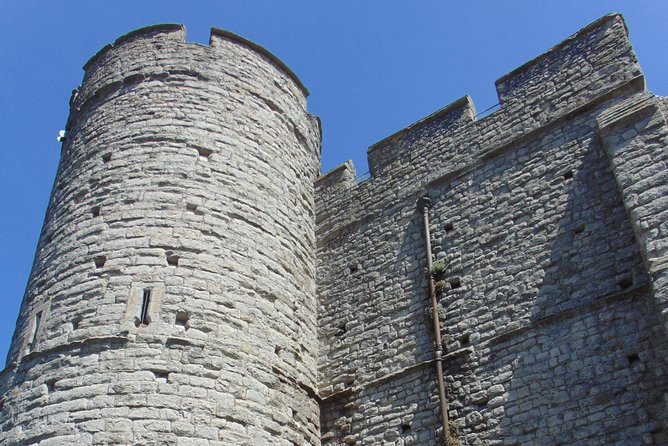
Next comes Westgate Towers Museum & Viewpoint, centered on the fact that Canterbury’s biggest medieval gate survived, and because of that, you can learn what it was made to do.
What I find especially useful here is the framing. A city gate is easy to romanticize as a postcard wall. But this stop focuses on function: methods of attack and defence, and how a gate becomes an engineering solution for a turbulent time. The guide also treats the tower like a narrative, with the kind of backstory that makes you understand why it was built the way it was.
One practical note: admission is not included at this stop. So if you want the museum and viewpoint elements inside, you will likely pay extra. Still, even if you skip entry, the outdoor explanation gives you context so you know what you are looking at.
If you love architecture, or you enjoy history that explains how people lived under pressure, this is one of the strongest stops.
Same part of England, a different sort of day out:
- Howletts Day Ticket
★ 4.5 · 42 reviews - Small-Group City Running Tour in Canterbury
★ 5.0 · 33 reviews - Private Guided Walking Tour of Canterbury
★ 5.0 · 23 reviews - The Best of Kent: a private 3 hour minibus tour with an expert
★ 5.0 · 21 reviews
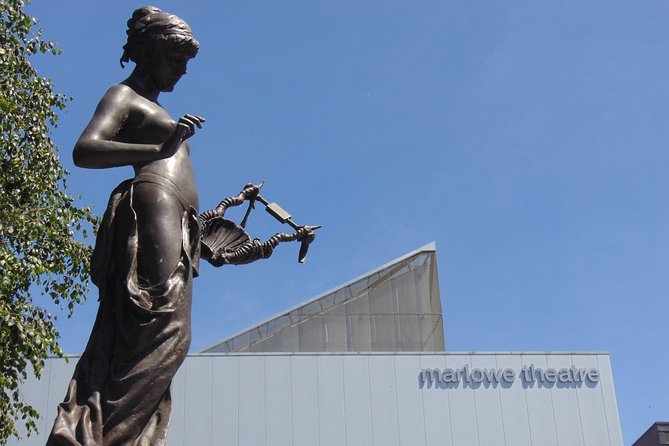
Stop 3: Marlowe Theatre and How Written Power Shows Up in Modern Buildings
From the medieval era, the tour moves to something modern: the Marlowe Theatre. That contrast is smart. Canterbury did not stop being relevant when medieval walls were raised. It kept adapting, and the written word kept mattering.
Here the story centers on Christopher Marlowe, and how his life connects to Canterbury. You are passing a modern theatre, but you are not being asked to ignore the past. Instead, you learn how cultural identity keeps showing up in new forms.
Again, no entry fee is included for this particular stop. It is mainly a guided pass-by with interpretation, so you do not need to time your day around buying tickets.
This stop is good for you if you like how guides link people to places, not just dates to buildings. It also helps if you are traveling with teens who get bored when tours stick only to old stones.
Stop 4: Christ Church Gate, and the Tudor Prince You Might Not Expect
Then you hit Christ Church Gate, another landmark where the story beats the assumptions.
This gate connects to a Tudor prince and a Spanish bride, but the guide makes a point of the twist. It is not the prince you might first think of. That small detail matters, because it shows you how easily city history can be misread if you only rely on your first guess.
What you get at this stop is also an explanation of how gates change over time. You learn that these structures are not frozen in place. They get altered, repurposed, and reshaped as the city’s needs shift.
Like several other stops, this is mostly an outdoor orientation stop, so you are not committing to a long museum visit. If you want the quick hit of meaning behind a recognizable gate, this part delivers.
Stop 5: Roman Canterbury Clues, WWII Rediscovery, and Butchery Lane Oddities
Now you move into a section that feels like Canterbury showing off its secret layers.
You stop outside the Canterbury Roman Museum and hear about the Roman city, including how the Roman past was rediscovered thanks to the Second World War. That is a neat example of history coming back through surprising circumstances. It also changes the way you look at the city, because you start thinking about what could be underneath the pavement.
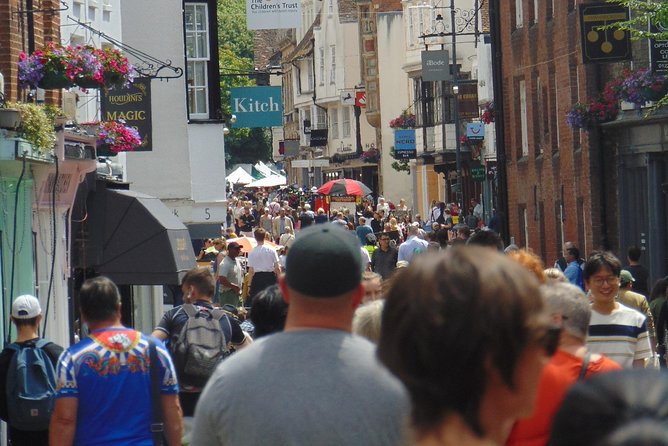
After that, the tour continues around Butchery Lane, where the guide points out more visual clues, including the Bell Harry Tower area, the city coat of arms, and a bull’s head that is easy to miss if you are just walking and shopping.
Here is why I like this stop: it teaches you how to hunt for meaning. When the guide calls attention to details like a coat of arms or a quirky statue, you learn the habit of looking. That means after the tour, you can keep spotting things on your own, even when you are not near the planned landmarks.
This stop is a great fit if you want Canterbury to feel fun, not only solemn. It also helps if you are traveling with kids or teenagers, because these specific, odd details give them something to watch for.
Stop 6: St Thomas of Canterbury RC Church, Thomas Becket, and the Dove in the Ear
Then the tour lands at St Thomas of Canterbury RC Church for a story built around Thomas Becket.
The guide’s angle here is clear and accessible: you get the full story of Thomas Becket, including the fact that he is not from Canterbury, yet he becomes one of the most important figures in the city’s history. That framing helps you understand why Canterbury became a magnet for pilgrimage in the first place.
You also get the kind of strange religious symbolism that makes this tour memorable. The stop includes an explanation involving Pope Gregory the Great and a dove flying into his ear.
That sounds unusual, and it is. But in this context, it is not random oddness. It helps you see how medieval and medieval-linked stories traveled through imagery, sermons, and public belief. It also ties into the tour’s overall theme of wrong-placed-but-important symbols.
This is one of the stops that tends to stick with people after they go back to their hotel. If you like your history with a little supernatural symbolism and a clear human story, you will probably enjoy this moment most.
Stop 7 and the Finish: Saint George’s Tower and the Clock That Anchors Today
The tour ends underneath Saint George’s Tower, a clock tower tied to the former St George’s Church.
This is a satisfying finish because it shows you how old structures can survive while the surrounding area changes into a modern shopping zone. You are not only learning about what Canterbury used to be. You are learning how Canterbury became what it is now, with historic reminders built into everyday streets.
If you like the idea of history living in plain sight, this stop is exactly that. You can look up, and the city gives you a visual payoff for everything the guide has been explaining.
The tour is designed to come to a clean ending point that you can easily use afterward. Once you are done, you are in the center where you can keep exploring without having to retrace steps.
Price and Value: Why This 19-Dollar Walk Feels Like More
At $19.44 per person for about 1 hour 30 minutes, this tour is priced in a way that feels like great value for a first pass through the city center.
Why? Because you are not paying only for the walking. You are paying for:
- a guided route that hits major story anchors quickly
- interpretation that makes architecture and small details meaningful
- time saved from figuring out what matters on your own
Also, the group limit to 10 travelers helps the value feel real. When you can ask questions and get answers that match your interests, you get more out of every stop.
One more pricing-related detail: a few stops have admission not included, so you can choose how far you want to spend beyond the tour fee. If you like museums and want viewpoints, you can add them. If you prefer a lighter, mostly outdoor walk, you still get plenty from the guided storytelling.
Another small value signal: this tour is commonly booked around 33 days in advance on average. That suggests it is in demand. If you are visiting during peak season or on a weekend, I would book early so you do not get stuck with a less convenient time.
Who This Tour Suits Best (and Who Might Find It Less Useful)
This is ideal if:
- it is your first time in Canterbury and you want orientation fast
- you like walking tours that focus on buildings, symbolism, and story
- you travel with teens or kids who still need moments to laugh, notice, and ask questions
- you want a compact route that covers a wide time span without overcommitting
It may be less ideal if:
- you only want cathedral-focused time and plan to spend the majority of your day inside
- you dislike walking outdoors or standing around at viewpoints
- you expect every stop to be an included ticketed attraction (because some entry fees are not included)
If you want Canterbury to feel like a place you can read, not just photograph, this tour is a strong first move.
Practical Tips for Getting the Most From Your 90 Minutes
A walking tour with frequent landmark pauses is all about setup.
- Wear layers. Even with a short route, you will be outside for stretches. One of the nice surprises in the reviews is that the guide can keep things fun even in freezing weather.
- Bring a curious mindset. The tour leans into quirks like clocks, symbolism, and details that are easy to miss. If you come expecting only serious facts, you might miss half the point.
- Ask questions early. With a small group, asking one question can lead to a mini story that helps you understand later stops too.
- Decide on museum add-ons. At least one stop involves a viewpoint museum with admission not included. If you care about that, budget time and money. If you don’t, focus on the guide’s outdoor explanations.
Should You Book the Canterbury Classic Tour?
I think you should book it if you want a quick, story-driven introduction to Canterbury that goes beyond the obvious.
For a low price and a short time commitment, you get a structured walk that helps you interpret Chaucer-era storytelling, Roman echoes, Tudor gate drama, and the Thomas Becket story, plus the kind of odd symbolic moments that make the city feel alive. With a max of 10 and a guide who clearly knows how to keep a group engaged, this is a smart way to start.
If you already have a plan to spend long hours in ticketed museums, you might treat this as your orientation phase. Otherwise, it is a great stand-alone highlight.
FAQ
Is admission included for every stop?
No. Some stops are free, while others have admission not included. For example, Westgate Towers Museum & Viewpoint lists admission as not included.
How long is the Canterbury Classic Tour?
It runs for about 1 hour 30 minutes.
How many people are in the group?
The tour caps group size at a maximum of 10 travelers.
Where does the tour start and end?
It starts outside The Beaney House of Art and Knowledge at 18 High St, Canterbury, and ends underneath Saint George’s Tower at 27 St George’s St.
Is the tour offered in English, and do I need a paper ticket?
The tour is offered in English, and you’ll use a mobile ticket.
What is the cancellation policy?
Free cancellation is available up to 24 hours in advance for a full refund. If you cancel less than 24 hours before the experience starts, the amount paid is not refunded.
Recently added around Canterbury
- Murder and Miracles Self Guided Tour of Canterbury City★ 4.0 · 7 reviews
- The Best of Kent: a private 3 hour minibus tour with an expert★ 5.0 · 21 reviews
- Private Guided Walking Tour of Canterbury★ 5.0 · 23 reviews
- Howletts Day Ticket★ 4.5 · 42 reviews
- Privately Guided Tour of Canterbury and Canterbury Cathedral★ 4.0 · 3 reviews
- Small-Group City Running Tour in Canterbury★ 5.0 · 33 reviews
- Silver Ring Workshop in Kent, England★ 5.0 · 102 reviews
- Official Canterbury Guided Walking Tour – 14.00 Tour★ 5.0 · 214 reviews
Canterbury Tours, compared.

Official Canterbury Guided Walking Tour – 11.00 Tour
Read our review →
Official Canterbury Guided Walking Tour – 14.00 Tour
Read our review →


The Best of Kent: a private 3 hour minibus tour with an expert
Read our review →
Murder and Miracles Self Guided Tour of Canterbury City
Read our review →Browse the lists this tour appears in