
Reviewed · HISTORICAL TOURS
Oxford: 90 minute Architectural & Historical Highlights Tour
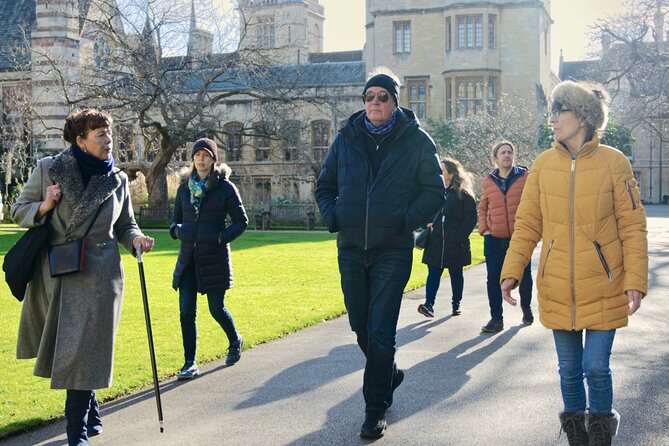
Oxford reads like a stone story. This 90-minute walk strings together Protestant martyrs, ancient gate towers, and the working heart of the university, with free entry to a medieval college.
Two things I especially like. First, the tour gives you real access moments, not just street views, so you get inside the feel of Oxford. Second, you leave with a complimentary map and guidebook, plus personal recommendations for where to eat and drink.
One drawback to plan for: it works best in good weather. You’ll be outside between close stops, so rain or wind can make the pace feel more tiring.
In This Review
- Key highlights worth getting excited about
- A free 90-minute Oxford primer that actually works
- Martyrs Memorial and St Michael at the North Gate: set the story early
- Exeter College: medieval entry plus Oxford Movement glow
- Lincoln to St Mary the Virgin: gates, stained glass, and the spire option
- Oriel College and Corpus Christi: rowing, windows, and animals that feel alive
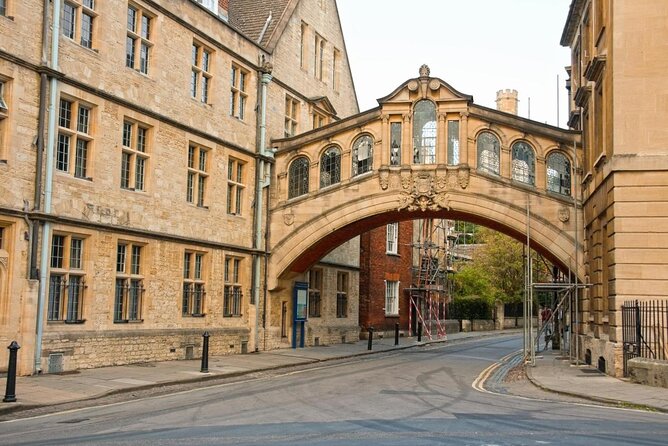
- Merton College and Examination Schools: college founding and the exam machine
- Queen’s College and the High Street: Marmalade, coffee, and London’s old road
- New College to the Sheldonian Theatre: gates, film sets, and ceremonies
- Divinity School, the Bodleian, and Radcliffe Camera: from 15th-century rooms to millions of books
- Balliol College and what to do when you finish at Golden Cross
- Who this tour is best for, and who should look elsewhere
- Should you book this Oxford highlights tour?
- FAQ
- How long is the Oxford Architectural and Historical Highlights Tour?
- What is the meeting point and end point?
- Is pickup offered?
- What languages is the tour offered in?
- Does the tour include entry to a medieval college?
- Are admissions included for the stops?
- Is there a group size limit?
- What happens if the weather is bad?
Key highlights worth getting excited about
- A tight 90 minutes that hits major architecture beats without dragging
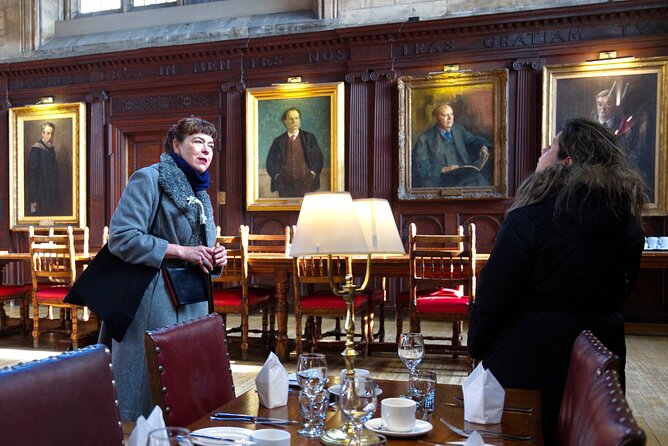
- Entry to Exeter College, with chapel inspiration tied to the Oxford Movement and St Chapelle
- Stop-by-stop context that turns college walls into stories about religion, power, exams, and science
- You see the university machine up close, from stained glass to the Bodleian’s huge collections
- Balliol College is timed, but ticketed entry is not included, so plan accordingly
- Small group size, capped at 15 travelers, keeps the tour from feeling rushed or chaotic
A free 90-minute Oxford primer that actually works
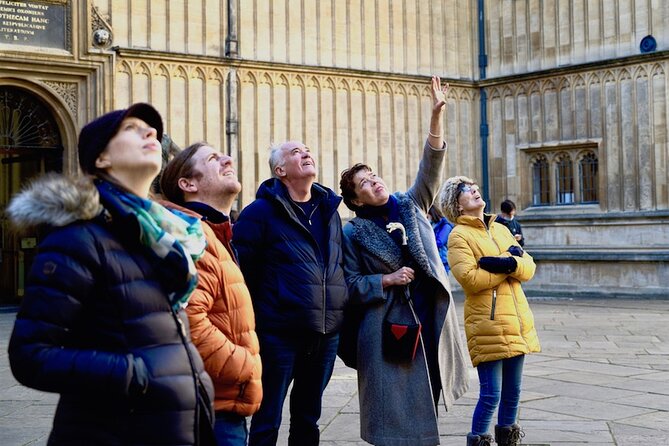
If you have limited time in Oxford, this kind of tour is exactly what you want. It is built as a sequence of short stops, moving you from one “why it matters” moment to the next. The big win here is compression: you leave with names, styles, and themes you can use immediately when you explore on your own.
And yes, the price matters. This experience is listed at $0, which turns the question from Is it worth it? into What’s the catch? The answer is that the value comes from the structure and the access. Many stops are marked as free, and you also get a complimentary map and guidebook so you can extend the day without buying extra paper.
The other practical advantage is the group size cap of 15. That keeps the guide able to handle questions and small detours. It also helps with pacing, since most stops are only a few minutes long. Short stops work when the guide keeps the story moving.
Finally, the route is centered. You start at Weston Library on Broad Street and finish at Golden Cross. You’re not zigzagging the whole city, which is a relief in Oxford, where lanes and college walls can make you feel like you’re hunting for entrances.
More History Tours in Oxford
- Natural History Museum Tour – by Uncomfortable Oxford™
★ 4.5 · 17 reviews - Oxford Pub Tour: Historic Pubs and Local Brews
★ 5.0 · 10 reviews - History of Medicine Tour – by Uncomfortable Oxford™
★ 4.5 · 8 reviews
Martyrs Memorial and St Michael at the North Gate: set the story early
The tour begins at Martyrs’ Memorial. This is a Victorian monument tied to Protestant martyrs from the 1500s. It’s not just a statue, it’s a message about Oxford’s religious tensions and how 16th-century conflict echoed into later centuries. Even in a quick stop, it gives you a lens for what you’ll see in college chapels and university spaces later on.
Next comes St Michael at the North Gate. This Anglo-Saxon tower was part of Oxford’s medieval city gate, and it’s described as likely the oldest surviving building in Oxford. That’s a rare feeling in a college city: you get something close to the earliest layers. The guide’s job at this point is to help you read the building like evidence, not just a backdrop.
Tip for you here: when the guide points out what is oldest, what is surviving, and what was rebuilt, keep your mental “layers” map running. Oxford is all about time stacked on time, and this start trains your eye fast.
Exeter College: medieval entry plus Oxford Movement glow
At Exeter College, you’re not just looking at a famous place, you’re hearing how ideas shaped architecture. The description focuses on Exeter’s chapel, inspired by the Oxford Movement and modeled on Paris’ St Chapelle. That connection matters because it shows Oxford did not develop in a vacuum. It looked outward, borrowed forms, and adapted them to its own religious debates.
Exeter also ties Oxford to famous names. The tour notes graduates including Philip Pullman, J. R. Tolkien, and Alan Bennett. That mix is useful. It tells you Oxford isn’t only about theology or medieval buildings. It’s a pipeline that later fed English literature and storytelling.
A small caution: this is a highlights tour, so you’ll see what the guide prioritizes. If you want deep time inside chapels, plan to come back after. The payoff here is context plus entry to a medieval college, not an hour-long stop in one room.
Lincoln to St Mary the Virgin: gates, stained glass, and the spire option
Lincoln College is a quick but telling stop because it’s about the relationship between the university and the city. Its original face onto Turn Street is framed as a clue to how Oxford began, and how early university power sat in the middle of everyday streets.
Then you move to the University Church of St Mary the Virgin, and this is one of those stops where Oxford feels like an academic institution built on older foundations. The church is noted as the university’s first building and is listed in the Doomsday Book. That’s an attention-grabber for any first-time visitor.
The tour also points you toward the stained glass, and it ties the church to CS Lewis. It even notes that you can climb the spire if you want. That spire choice is great for you because it turns a short visit into a view-based memory. If climbing is open and you feel up for it, it is one of the easiest ways to add a “wow” moment without extra travel time.
Downside to consider: you may not get a full experience of every interior detail, since the stop is around 7 minutes. Go in expecting highlights, not a slow museum visit.
Same part of England, a different sort of day out:
- Oxford University Walking Tour With University Alumni Guide
★ 5.0 · 6,905 reviews - Oxford Castle and Prison Guided Tour
★ 5.0 · 1,402 reviews - 1.5-hour Oxford City and University Walking Tour
★ 4.5 · 1,383 reviews - Oxford Official University & City Tour
★ 5.0 · 1,134 reviews
Oriel College and Corpus Christi: rowing, windows, and animals that feel alive
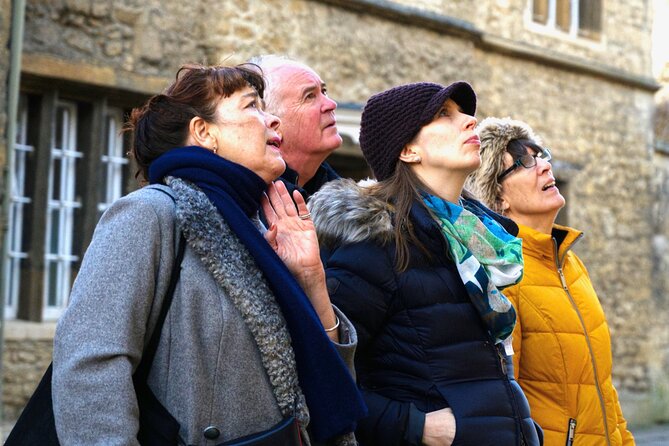
At Oriel College, the standout points are practical and visual. It’s one of the university’s oldest colleges and it’s famous for rowing. The front quad and the Oriel windows are singled out as stunning. There’s also a fun nearby connection: Oriel is described as neighbors with Corpus Christi, which hosts the annual tortoise race.
Then you pass east of Christchurch, with a suggestion to return for the Christchurch Picture Gallery behind the eastern entry. Even if you do not have time right then, that kind of prompt is gold. It helps you spot a future detour instead of letting it fade.
Corpus Christi is another great architecture read. The description emphasizes early 16th-century building style and focuses on moving figures of animals, including a pious pelican. That’s the kind of detail that makes you look harder at carvings, instead of treating college exteriors like uniform stone blocks.
The stop also mentions a cobbled street that is listed as a national treasure. Even if you only catch a glimpse, you’re being trained to see the “micro” Oxford moments, the little streets and textures that make the city feel older than the calendar.
Merton College and Examination Schools: college founding and the exam machine
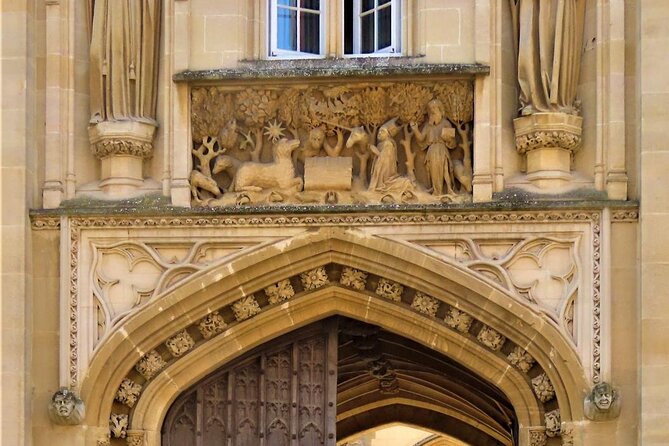
Merton College is framed as Oxford’s third college, and it’s easy to see why the tour loves it. There’s a favorite note about the 15th-century frieze over the gatehouse telling the tale of the founding of colleges. That’s a neat trick. Instead of just admiring the gate, you’re learning to treat the carvings as a narrative timeline.
The chapel’s flying buttresses are highlighted as richly decorated. It’s a reminder that Oxford’s religious architecture was also art and engineering.
Then there’s the Bodleian connection. Thomas Bodley, founder of the Bodleian Library, is mentioned as a Merton graduate. The stop also notes that Merton College’s library is the oldest continuously surviving library in Oxford. That matters because it gives you a direct line from “Oxford buildings” to “Oxford knowledge.”
The Examination Schools stop shifts the mood from colleges to formal education. The tour notes Oxford University’s first written exam in the early 19th century and describes the building as a Victorian extravaganza mixing Jacobean and Tudor styles. It also ties this building to an egalitarian idea, making education available more widely.
Why you’ll like this part: it gives Oxford more modern muscle. After all the chapels and gates, you see how the university organized testing and credentialing. Oxford is old, yes, but it also runs on systems.
Queen’s College and the High Street: Marmalade, coffee, and London’s old road
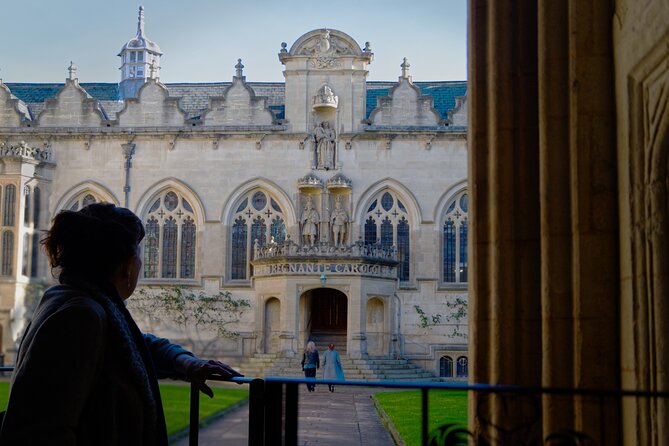
Queen’s College is introduced with a pop-culture hook: it’s the alma mater to Rowan Atkinson. That’s a clever bridge for you if you’re trying to connect architecture to modern life. The stop then moves into real foundations, since the college was founded for poor scholars from the north of England. One of these scholars became wealthy and helped fund an 18th-century rebuilding, with designs contributed by Christopher Wren and Nicholas Hawksmoor.
Then the tour turns to the High Street, and this is where your “Oxford beyond colleges” instincts get rewarded. The High Street is identified as the road to London. It also notes that Frank Cooper’s Marmalade was first made here, later becoming a worldwide fad. That’s the kind of detail you would never guess from the stone facades.
The tour also points to England’s first coffee house, tied to a moment when Jewish people were welcomed back into the UK after long exclusion, associated with Oliver Cromwell’s period. The takeaway you should keep is not the date trivia. It’s that Oxford’s commercial and civic life has its own layered history, not just academic drama.
This stop is a good example of why the tour feels practical. You’re leaving with story threads that connect to everyday Oxford.
New College to the Sheldonian Theatre: gates, film sets, and ceremonies
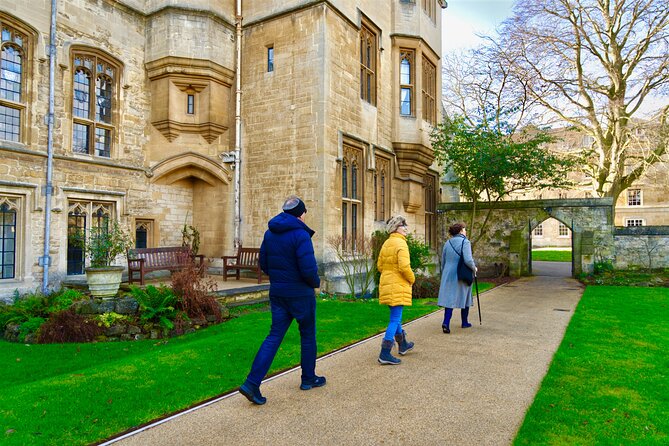
New College brings in the medieval aftershocks. The gates are described as telling the tale of its foundation after the plagues of the 14th century. That gives a stark emotional background to what might otherwise feel like postcard architecture.
The tour also notes that the charming setting has been used in film sets. That’s helpful because it explains why you might feel like you’ve seen it before, even if you’ve never been.
Then comes the Sheldonian Theatre, Oxford’s stage for university ceremonies. The description says it’s a 17th-century home for those rituals and suggests it may be the first building by Christopher Wren. It also notes that the architect is linked to astronomy and photography at Oxford University.
This part is about recognizing ceremony as part of how universities project power. Oxford is not only studying. It is performing its identity to itself.
Divinity School, the Bodleian, and Radcliffe Camera: from 15th-century rooms to millions of books
Oxford Central Library is a stop that ties old spaces to modern public access. The description says the library was built on top of the medieval perpendicular Divinity School. It also mentions the Duke Humphrey Library, a 15th-century room housing a gift of over 200 books from the King’s brother.
There’s also a fun film anchor. The stop notes that these rooms were selected for Harry Potter scenes. That gives you a reason to look at architectural framing, sightlines, and room proportions, not just the books. You get a visual memory hook for later.
Next comes the Bodleian Library itself, which the tour calls out for scale and continuity. It notes that the Bodleian has over 13 million books. You’ll also learn about the origins and how the library still works today. Even in a short stop, the point is clear: Oxford did not just collect books for display. It built a system that still runs.
Then you reach Radcliffe Camera, described as Oxford’s first science library. Sir John Radcliffe is highlighted as its eccentric and generous benefactor. This stop helps you rebalance the story. Libraries and science do not sit outside Oxford’s heritage. They are part of it.
Practical note for you: these stops move quickly. If you are a book person, the best move after the tour is to return with a ticket when you have time. The highlight here is learning how to “read” the libraries as institutions, not just impressive rooms.
Balliol College and what to do when you finish at Golden Cross
Balliol College is where you get a longer 15-minute moment. The tour frames it as a place where undergraduates started to have access to the university and its colleges. That’s a key shift. It helps you understand that Oxford’s structure evolved, and access expanded over time.
One practical detail: admission for Balliol is marked as not included. So treat the Balliol stop as time with the guide and the exterior or accessible areas included, and expect that entering specific indoor spaces could require your own ticket.
When you finish at Golden Cross, you’re in a good position to keep exploring. You’ll already have the complimentary map and guidebook, and you’ll have learned enough names and architectural cues to navigate by pattern. If the guide gave you food and drink recommendations, this is when you use them. Oxford evenings are where the city stops being a sightseeing problem and becomes a place to linger.
Who this tour is best for, and who should look elsewhere
This tour is a strong fit if:
- You’re doing Oxford for the first time and want a fast, coherent route
- You care about architecture and want stories behind styles, from Anglo-Saxon towers to Victorian exam halls
- You want at least one medieval college entry plus a tour that ends with clear suggestions for what to do next
- You prefer small groups, with a cap of 15 travelers
It may not be ideal if:
- You want hours of deep interior time in any single library or college
- You’re planning around a specific Balliol interior space that requires ticketed admission
- You’re visiting when weather is likely poor, since the tour requires good weather
Should you book this Oxford highlights tour?
Yes, if you want a high-value Oxford orientation that turns into a roadmap for your own exploring. The standout reason is the mix of free admission moments and the fact that you’re not just collecting photos. You’re getting the “why” behind gates, chapels, stained glass, libraries, and exam halls, and then you get a map and guidebook to keep going.
Book it especially if your time in Oxford is tight. Ninety minutes is enough to understand the city’s logic, then you can spend the rest of your day choosing your own rabbit holes, like the suggested Christchurch Picture Gallery stop.
If you want my simple rule: choose this tour when you want direction. Skip it only if you already know Oxford well and you are hunting for slow, detailed indoor access at a single site.
FAQ
How long is the Oxford Architectural and Historical Highlights Tour?
The tour lasts about 1 hour 30 minutes.
What is the meeting point and end point?
You start at Weston Library, Broad Street, Oxford OX1 3BG, and you end at Golden Cross, Oxford OX1 3EU.
Is pickup offered?
Yes, pickup is offered.
What languages is the tour offered in?
The tour is offered in English.
Does the tour include entry to a medieval college?
Yes. The tour includes entry to a medieval college, with Exeter College being one of the highlighted college stops.
Are admissions included for the stops?
Most stops are marked as free admission in the tour information. Balliol College is specifically marked as Admission Ticket Not Included.
Is there a group size limit?
Yes. The tour has a maximum of 15 travelers.
What happens if the weather is bad?
This experience requires good weather. If it is canceled due to poor weather, you will be offered a different date or a full refund.
Recently added around Oxford
- Harry Potter PUBLIC Tour + Self Guided Christ church Daily 12.45★ 5.0 · 82 reviews
- Discovering Cheltenham: A Self-Guided Audio Tour★ 4.5 · 23 reviews
- Harry Potter PRIVATE Tour + Self Guided Christ church Daily 12.45★ 5.0 · 32 reviews
- Oxford’s Historic Pubs: A Self-Guided Walking Tour★ 5.0 · 5 reviews
- History of Medicine Tour – by Uncomfortable Oxford™★ 4.5 · 8 reviews
- Natural History Museum Tour – by Uncomfortable Oxford™★ 4.5 · 17 reviews
- Oxford Pub Tour: Historic Pubs and Local Brews★ 5.0 · 10 reviews
- River Cruise with Three Course Riverside Restaurant Dining★ 5.0 · 201 reviews
Historical Tours, compared.


Shadows of York: Ghost Walk and Horrible History.
Read our review →
A Walk Through Time: History of Liverpool Walking Tour
Read our review →
Royal Historic Pubs Walking Guided Tour in London
Read our review →
Private Group: Historical Pub Walking Tour of London
Read our review →
Best Of Liverpool Heritage, History & Culture Guided Walking Tour
Read our review →Browse the lists this tour appears in